Introduction: Why 2026 is the Year of “Always-On” Finance
As of January 30, 2026, the traditional “Monthly Close” is becoming a relic of the past. Continuous Finance 2026 is the new global standard where financial statements are updated in real-time, every second of every day. Driven by the convergence of Agentic AI and Instant Payment Rails (like FedNow and UPI 3.0), companies are moving toward a state of permanent audit-readiness.
According to the Deloitte Finance Trends 2026 Report, 64% of finance leaders are now prioritizing “The Speed Priority,” making Continuous Finance 2026 the most searched term among Fortune 500 executives this morning.

Table of Contents
1. The Mechanics of Continuous Finance 2026
The shift to Continuous Finance 2026 is built on three core technological foundations:
Automated Ingestion & Reconciliation
AI agents now handle 98% of data ingestion from ERPs and sub-ledgers. Instead of waiting for the end of the month to “match” invoices to payments, Continuous Finance 2026 protocols do this at the moment of the transaction.
Event-Driven Accounting
In the old world, a sale triggered a ledger entry days later. In Continuous Finance 2026, every business “event”—a warehouse shipment, a software subscription renewal, or an energy micro-payment—triggers an immediate, cryptographically signed ledger update.
Instant Treasury Liquidity
With real-time visibility, CFOs no longer need “buffer cash.” Continuous Finance 2026 allows for Dynamic Liquidity Management, where excess cash is automatically moved into yield-bearing tokenized assets within milliseconds.
2. Continuous Finance vs. Traditional Accounting
The transition is stark. Businesses that fail to adopt Continuous Finance 2026 face higher capital costs and slower decision cycles.
| Feature | Traditional Accounting | Continuous Finance 2026 |
| Reporting Cycle | Monthly / Quarterly | Real-Time / On-Demand |
| Data Entry | Manual / Batch Processing | Autonomous AI Ingestion |
| Audit Style | Annual Retroactive Review | Continuous Control Monitoring (CCM) |
| CFO Role | Historical Reporter | Real-Time Strategy Orchestrator |
3. Implementation: Getting Started with Continuous Finance 2026
To implement Continuous Finance 2026, CFOs are adopting a “top-down” strategy as recommended by the PwC 2026 AI Predictions.
- Deploy an AI Studio: Centralize reusable tech components for automated reconciliations.
- Unify the Data Layer: Break down silos between ERP, CRM, and payroll systems to ensure a “Single Source of Truth.”
- Adopt Agentic Insights: Use AI agents to draft real-time narratives for board-ready commentary as events happen.
The Technology Stack of 2026
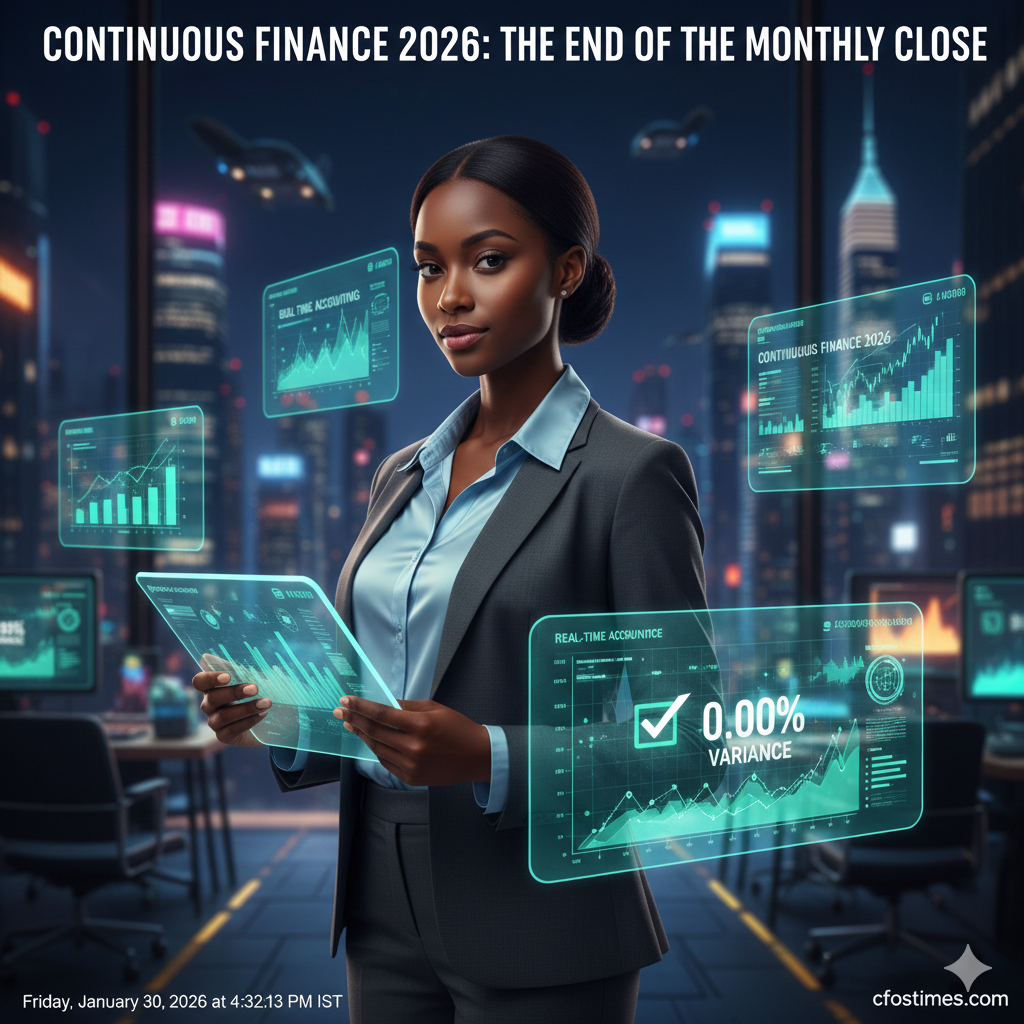
To transition to Continuous Finance 2026, the legacy “patchwork” of disconnected spreadsheets is being replaced by a Unified Finance Stack. Leading CFOs are prioritizing three specific layers:
- The Intelligence Layer (Agentic AI): Autonomous agents that monitor every transaction 24/7 to detect anomalies and perform real-time “ticking and tying.”
- The Connectivity Layer (API Ecosystems): Direct data streams between your bank, ERP (like NetSuite or SAP), and procurement tools, ensuring zero manual data entry.
- The Reporting Layer (Dynamic Dashboards): Replacing static PDFs with live financial cockpits that update the Balance Sheet and P&L with every cleared invoice.
Strategic Benefits for the 2026 Boardroom
- Reduced Capital Costs: Lenders in 2026 offer better rates to “Transparent Firms” that provide live API access to their financial health.
- Talent Retention: By automating 90% of routine reconciliations, you solve the “Accountant Shortage” by allowing your team to focus on high-value advisory work.
- Fraud Prevention: Continuous monitoring catches duplicate payments or phishing attempts in milliseconds, rather than weeks later during the month-end review.
The Challenges: Overcoming the “Cultural Close”
The biggest hurdle isn’t tech; it’s the mindset. Traditional teams are used to the “Batch” mentality. Continuous Finance 2026 requires a shift toward “Micro-tasks”—addressing exceptions daily so that the final “close” at year-end is simply a non-event.
FAQs: Continuous Finance 2026
Q1: Is Continuous Finance 2026 secure?
Yes. By using Continuous Control Monitoring (CCM), AI identifies anomalies and potential fraud the moment they occur, rather than discovering them weeks later during a month-end review.
Q2: Does this replace accountants?
No. It shifts the role. Accountants in the Continuous Finance 2026 era focus on judgment, interpretation, and scenario planning rather than data entry and reconciliation.
Q3: Can small businesses use Continuous Finance 2026?
Absolutely. Cloud-based ERPs have already integrated UCP (Universal Commerce Protocol) and real-time rails, making this accessible for SMEs as of late 2025.
Q4: How does the Union Budget 2026 impact this?
The upcoming Budget 2026 (expected Feb 1) is rumored to include mandates for “Real-Time Tax Compliance,” making Continuous Finance 2026 a legal necessity for many.
Conclusion: The Future is Real-Time
Continuous Finance 2026 is not just a trend; it is the inevitable evolution of the global economy. In a world moving at machine speed, “Monthly Reporting” is no longer fast enough. The CFOs who thrive in 2026 will be those who embrace the “Always-On” model, turning finance from a back-office function into a real-time competitive advantage.
Stay updated on the latest regulatory shifts with the Ministry of Finance Department of Financial Services.
Disclaimer
The information provided in this article, including insights on Continuous Finance 2026, is for informational and educational purposes only. It does not constitute professional financial, investment, legal, or tax advice. Financial strategies and technology implementations involve inherent risks; always consult with a certified financial advisor or a qualified professional before making significant business decisions. cfostimes.com and its authors are not liable for any financial losses or damages resulting from the use of this information.

Dr. Dinesh Kumar Sharma is an award-winning Chief Financial Officer and Director of Finance with over 25 years of expertise in strategic planning and digital transformation. Recognized as a five-time CFO of the Year, he specializes in leveraging Generative AI and Microsoft Copilot to optimize financial forecasting and cost management. Dr. Sharma holds a Doctorate in Management (Finance) and has successfully scaled organizations from INR 1 billion to INR 7 billion. He is dedicated to providing transparent, data-driven insights for modern decision-makers at CFOs Times.