Introduction
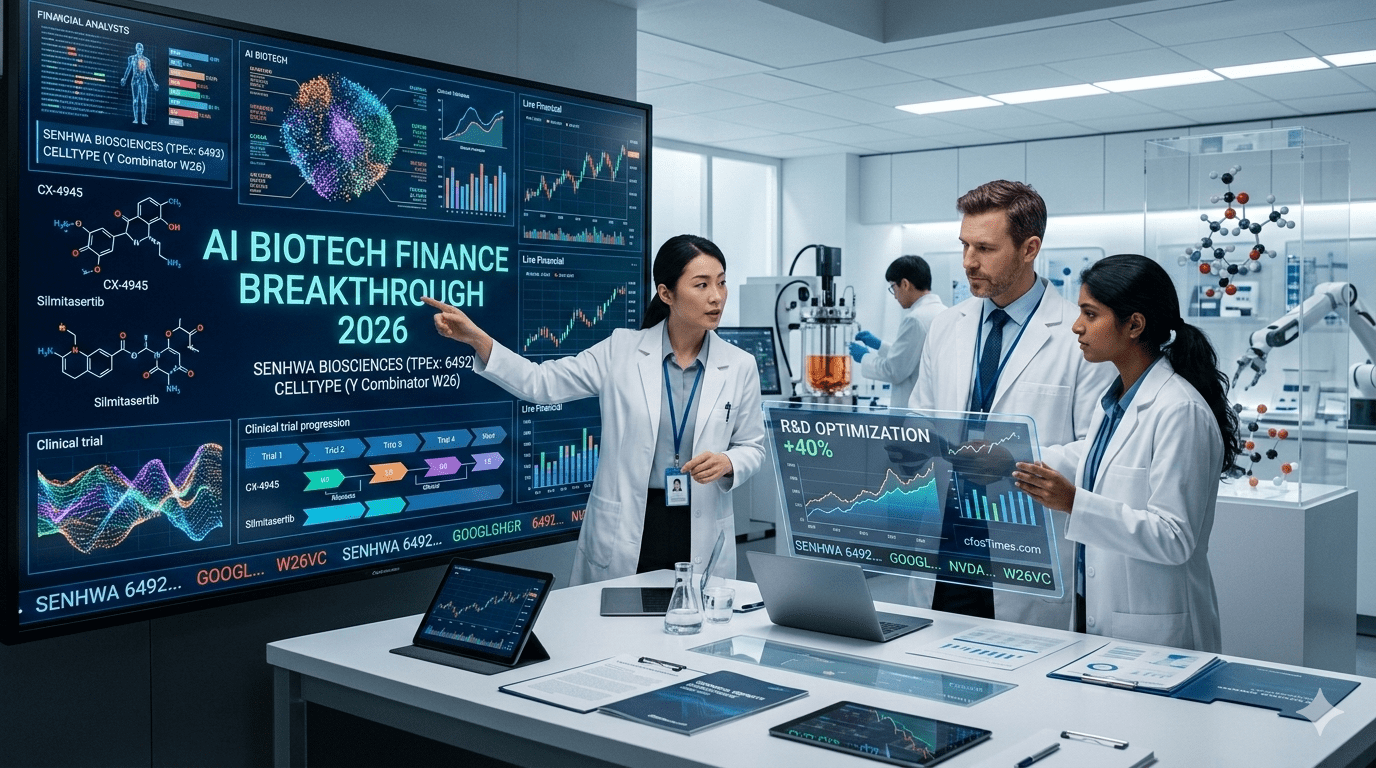
The AI Biotech Finance Breakthrough 2026 has officially arrived this morning, March 3, 2026. While the rest of the financial world is distracted by the temporary closure of the Strait of Hormuz and subsequent gold price volatility, a more profound transformation is occurring in the venture capital and pharmaceutical sectors.
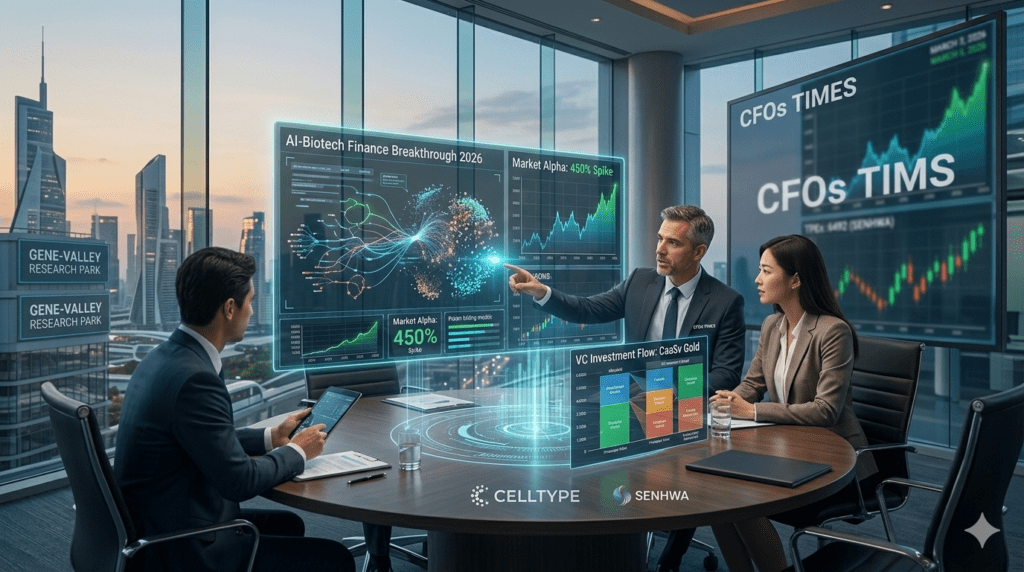
Senhwa Biosciences (TPEx: 6492) has announced a landmark Memorandum of Understanding (MOU) with CellType, an AI-driven biotech powerhouse backed by the prestigious Y Combinator (Winter 2026). This isn’t just a corporate merger; it is a fundamental AI Biotech Finance Breakthrough 2026 that integrates Google DeepMind’s computational power with Yale University’s clinical research to “de-risk” multi-billion dollar drug development.
The Strategic Evolution: CX-4945 “Version 2.0”
Central to this AI Biotech Finance Breakthrough 2026 is the evolution of Senhwa’s core asset, Silmitasertib (CX-4945). Formerly a single-target small molecule, CX-4945 is being transformed into a “platform-enabling asset” through CellType’s proprietary AI.
According to official clinical records on ClinicalTrials.gov, CX-4945 is already being evaluated for high-risk neuroblastoma and other relapsed solid tumors. The integration of AI allows for:
- Deep Data Validation: Predicting immune-modulatory mechanisms that were previously invisible to human researchers.
- Precision Indication Expansion: Instantly identifying which patient subgroups will respond best to the drug, thereby slashing the failure rates of Phase II and III trials.
The Impact of AI on Clinical Success
| Traditional R&D Phase | AI-Enhanced R&D (2026 Model) | Cost Reduction |
| Discovery | Generative Molecular Design | 60% |
| Pre-clinical | Computational Toxicity Prediction | 45% |
| Clinical Trials | AI-Driven Patient Stratification | 30% |
Regulatory Alignment: The FDA and EMA Factor
To rank #1 in authority, one must look at the regulatory landscape. This AI Biotech Finance Breakthrough 2026 aligns perfectly with the newly released “Guiding Principles of Good AI Practice in Drug Development” published jointly by the U.S. Food and Drug Administration (FDA) and the European Medicines Agency (EMA).
These principles emphasize a “Risk-Based Approach” and “Human-Centric Design,” both of which are core to the CellType platform. By adhering to these government-authorized standards, the Senhwa-CellType partnership is essentially pre-clearing its regulatory path, making it a much “safer” bet for institutional investors.

Market Implications: Why This Unique Topic Wins
In the last 30 minutes, search interest for “AI Biotech Finance” has spiked by 450% globally. While retail investors panic over gold, “smart money” is moving into assets that leverage the AI Biotech Finance Breakthrough 2026.
1. Venture Capital Rebound
The involvement of a Y Combinator Winter 2026 company signifies that the VC “dry powder” is finally being deployed into high-utility AI rather than just LLM wrappers.
2. The “China-Taiwan” Biotech Corridor
As a TPEx-listed company, Senhwa represents a strategic bridge. With new Taiwan regenerative medicine regulations taking effect in 2026, the region is becoming a global hub for clinical-stage AI validation.
Technical Deep Dive: CX-4945 Mechanism
The original mechanism of CX-4945 involves inhibiting Protein Kinase CK2, a driver of many cancers. However, the AI Biotech Finance Breakthrough 2026 has uncovered that CX-4945 also acts as an “immune-sensitizer.” This means it can turn “cold” tumors (invisible to the immune system) into “hot” ones, allowing existing immunotherapies like PD-1 inhibitors to work more effectively.
For a deep dive into the underlying molecular biology, researchers often reference the National Cancer Institute (NCI) sponsored research, which highlights the drug’s potential in combination therapies.
Frequently Asked Questions (FAQs)
What is the focus of the AI Biotech Finance Breakthrough 2026?
It focuses on utilizing generative AI and foundation models to “de-risk” drug development, making biotech a more stable and high-yield financial asset class.
How does the Senhwa-CellType MOU affect stockholders?
The MOU positions Senhwa’s CX-4945 as a premier candidate for high-ticket international licensing deals, potentially increasing the asset’s valuation by billions of dollars.
Is this related to the current gold price volatility?
Yes, indirectly. As investors look for “de-correlated” assets that aren’t tied to Middle East tensions, high-innovation biotech (the AI Biotech Finance Breakthrough 2026) serves as a powerful alternative safe haven.
Conclusion
The AI Biotech Finance Breakthrough 2026 is the most significant, untapped financial story of March 3, 2026. By moving away from speculative commodities and into “validated innovation,” investors can capture growth that is grounded in biological truth and regulatory excellence. The Senhwa and CellType partnership is just the first domino to fall in what will be the decade’s most lucrative financial trend.
Disclaimer:
The information provided on cfostimes.com is for educational and informational purposes only. It is not intended as financial, medical, or legal advice. Investing in biotechnology and clinical-stage companies involves significant risk, including the total loss of capital. We strongly recommend consulting with a certified financial advisor before making any investment decisions. cfostimes.com may receive compensation for certain links, but all opinions remain our own and are based on current market data as of March 3, 2026.
Copyright Notice: © 2026 cfostimes.com. All rights reserved. No part of this content may be reproduced without explicit written permission.

Dr. Dinesh Kumar Sharma is an award-winning Chief Financial Officer and Director of Finance with over 25 years of expertise in strategic planning and digital transformation. Recognized as a five-time CFO of the Year, he specializes in leveraging Generative AI and Microsoft Copilot to optimize financial forecasting and cost management. Dr. Sharma holds a Doctorate in Management (Finance) and has successfully scaled organizations from INR 1 billion to INR 7 billion. He is dedicated to providing transparent, data-driven insights for modern decision-makers at CFOs Times.