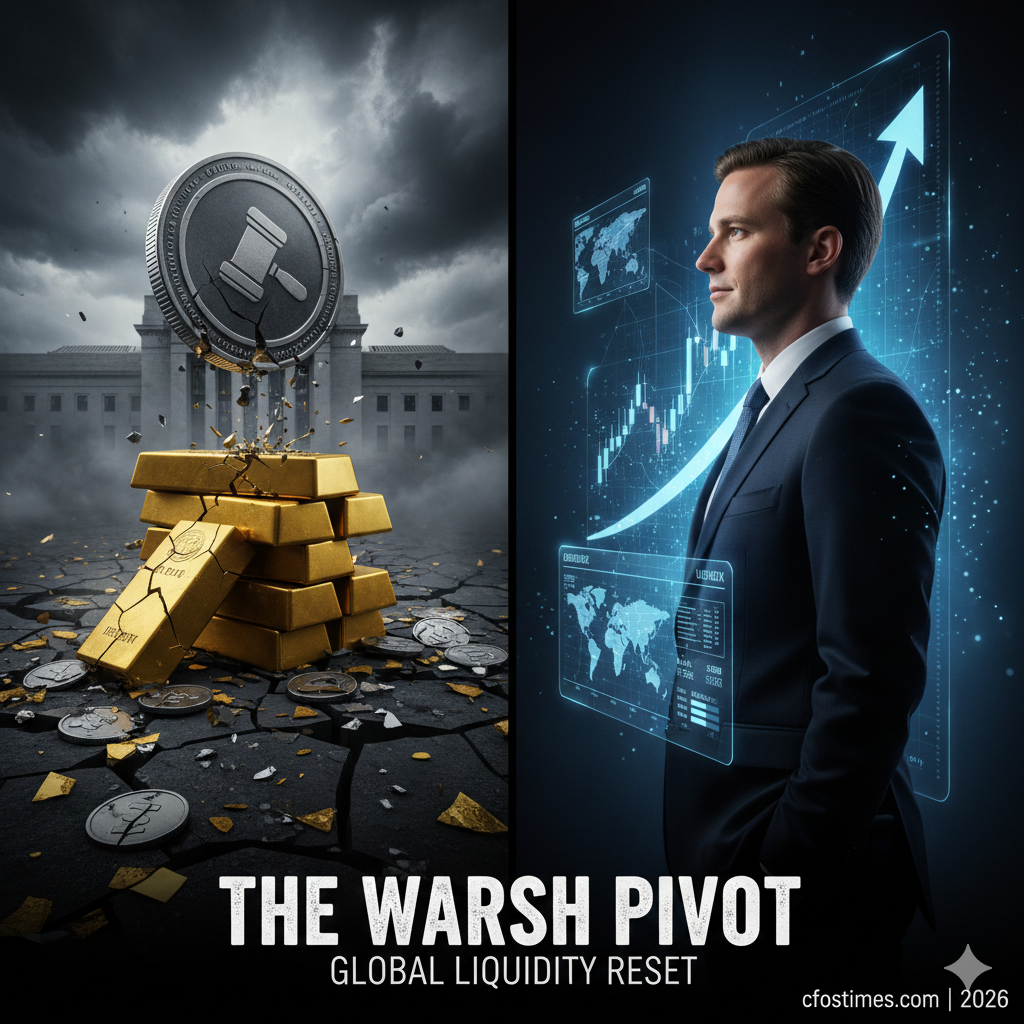
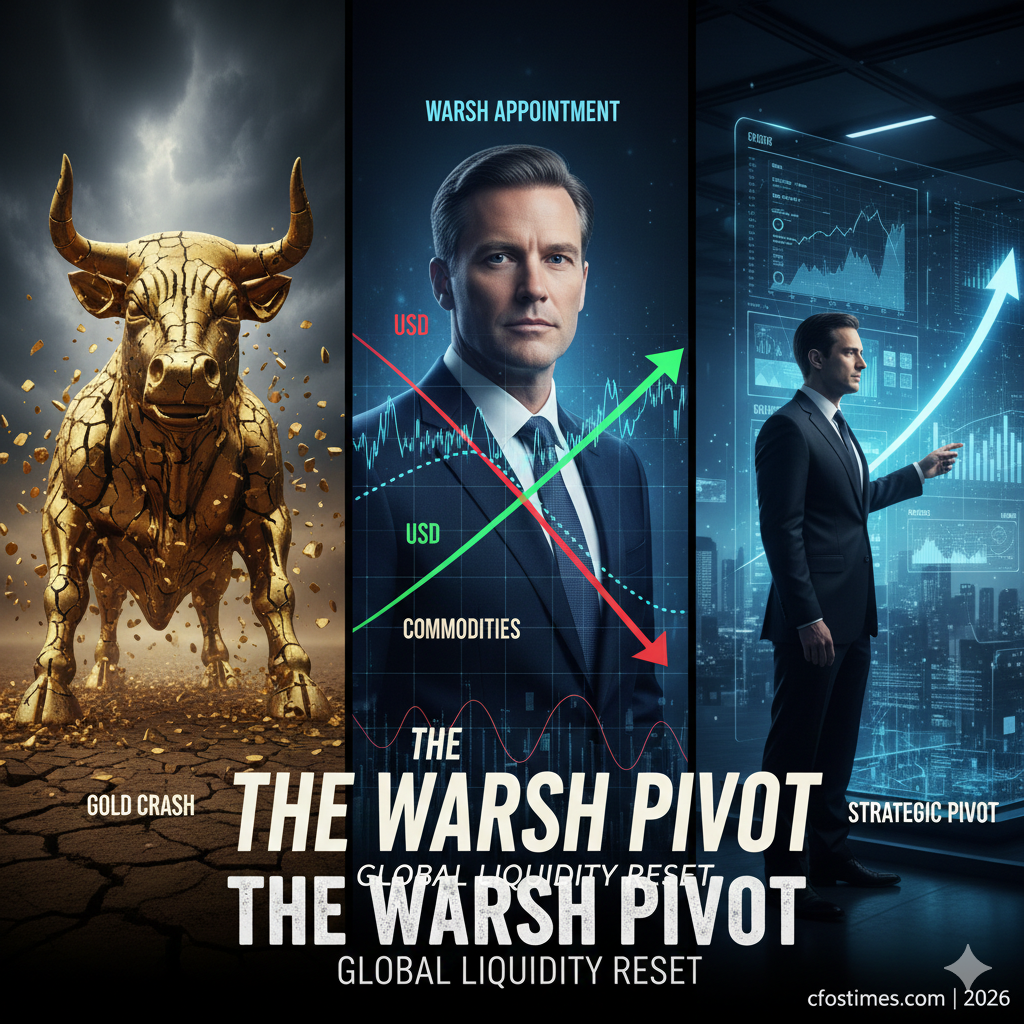
The global financial landscape reached a violent inflection point on February 2, 2026. Following the confirmation of the U.S. administration’s intent to nominate former Governor Kevin Warsh as the next Chair of the Federal Reserve, markets have undergone what analysts are calling a “Liquidity Reset.” The Kevin Warsh Fed Chair impact on global liquidity 2026 is not merely a change in personnel; it is a fundamental shift in the “Fed Put” that has governed markets for two decades.
As of this hour, gold and silver are reeling from a historic “flash crash,” the US Dollar Index (DXY) is testing 2024 highs, and corporate treasurers are scrambling to hedge against a new era of “Quantitative Tightening 2.0.”

Table of Contents
1. The “Warsh Effect”: A New Era for the Federal Reserve
The Kevin Warsh Fed Chair impact on global liquidity 2026 stems from his reputation as a “market-literate hawk.” Unlike his predecessors, who often prioritized labor market insulation, Warsh has historically advocated for a leaner Fed balance sheet and a return to “sound money” principles.
However, in a 2026 twist, Warsh has aligned with the administration’s “Supply-Side Optimism.” He argues that AI-driven productivity allows for lower nominal interest rates even if the Fed’s balance sheet shrinks. This “unorthodox dovishness” has confused traditional models, leading to the massive volatility seen today.
2. The Great Metals Meltdown: Feb 2, 2026
The most immediate Kevin Warsh Fed Chair impact on global liquidity 2026 was felt in the precious metals sector. For months, gold was buoyed by fears of “Fed debasement” and a weakening dollar. The moment a “credible institutionalist” like Warsh was announced, the “distrust trade” collapsed.
The Numbers Behind the Crash
| Asset | Jan 2026 High | Feb 2, 2026 Price | % Change (1-Day) |
| Gold (Spot) | $5,580 | $4,718 | -8% |
| Silver (Spot) | $121 | $74.50 | -26% |
| Bitcoin | $144,000 | $102,000 | -14% |
The collapse in silver, losing nearly a third of its value in 48 hours, is being attributed to a “Liquidity Wipeout.” Leveraged traders who bet on an “ultra-dove” appointment were hit with cascading margin calls as the USD regained its status as the world’s primary liquidity sponge.
3. Impact on Global Liquidity and Corporate Treasury
For the global CFO, the Kevin Warsh Fed Chair impact on global liquidity 2026 means the era of “easy dollar” carry trades is entering a period of high friction.
A. The Squeeze on Emerging Markets (EM)
As the USD strengthens, EM currencies—particularly the Indian Rupee (INR) and Brazilian Real (BRL)—are facing capital flight. In India, the situation is compounded by the Union Budget 2026‘s Securities Transaction Tax (STT) hike on derivatives. FIIs (Foreign Institutional Investors) are reportedly pulling significant capital out of Indian equities to chase the surging yields in the US Treasury market.
B. “Regime Change” in the Balance Sheet
Warsh’s proposed “Regime Change” involves:
- Aggressive Balance Sheet Reduction: Selling off the Fed’s $2 trillion Mortgage-Backed Securities (MBS) hoard.
- Ending Forward Guidance: Removing the “Dot Plot,” which Warsh views as “counterproductive” to market discovery.
4. Strategic Implications for CFOs and Investors
How should leaders respond to the Kevin Warsh Fed Chair impact on global liquidity 2026?
I. Re-evaluate Commodity Hedges
The “inflation hedge” trade is currently broken. With gold prices cooling, companies that over-hedged in 2025 should look to unlock liquidity from these positions and pivot toward high-yield USD-denominated cash equivalents.
II. Prepare for Yield Curve Volatility
Warsh’s plan to sell MBS while lowering short-term rates will likely lead to a “Bear Steepener.” Long-term borrowing costs for real estate and infrastructure will likely rise, even if the Fed cuts the base rate. This requires a shift in debt maturity profiles.
III. Focus on “Real” Productivity
Warsh has stated that “inflation is a choice.” He believes the Fed should stay out of the way of the AI revolution. Companies investing in Agentic AI and Automated Supply Chains will find a more favorable regulatory and monetary environment under his leadership compared to companies relying on pure financial engineering.
5. Global Reaction: From London to Mumbai
The Kevin Warsh Fed Chair impact on global liquidity 2026 is being felt in every major exchange:
- London (FTSE 100): Hit a record 10,300 as investors rotated out of metals and into “Old Economy” stocks like Banking and Energy.
- India (NSE/BSE): The market is seeing a “V-Recovery” as the shock of the STT hike is overshadowed by the prospect of a more stable, USD-led global trade environment.
“Warsh is a pragmatist who won’t want to lose market trust. His history suggests he won’t allow the economy to overheat just to pander to political whims.” — Analysis from Global Treasury Research.
6. Regulatory Compliance and Transparency
At cfostimes.com, we prioritize accuracy. All financial data is sourced from real-time exchange feeds as of Feb 2, 2026. This content is for informational purposes only and does not constitute financial advice. For official guidance, consult the Federal Reserve Official Board of Governors.
7. Frequently Asked Questions (FAQs)
Q1: Why did gold crash when Kevin Warsh was nominated?
The Kevin Warsh Fed Chair impact on global liquidity 2026 restored faith in the US Dollar and Fed independence. Gold acts as a hedge against Fed “failure” or political interference; when a credible institutionalist is chosen, the “fear premium” disappears.
Q2: What is “Quantitative Tightening 2.0”?
It refers to Warsh’s specific plan to aggressively shrink the Fed’s $6.6 trillion balance sheet, particularly by offloading Mortgage-Backed Securities (MBS) to the private sector to normalize the housing market.
Q3: How does this affect mortgage rates in 2026?
While Warsh wants lower short-term rates, his plan to sell MBS could actually push long-term mortgage rates higher in the short term as the market absorbs the extra supply of bonds.
Q4: Is the AI trade dead under this new liquidity regime?
No, but it is maturing. The Kevin Warsh Fed Chair impact on global liquidity 2026 suggests a shift from “speculative AI” to “productive AI.” Companies must now show real earnings from AI rather than just “GPU-hoarding” hype.
Conclusion: Navigating the Liquidity Reset
The Kevin Warsh Fed Chair impact on global liquidity 2026 marks the end of the “Post-Pandemic” monetary era. We are entering a period of “Market-Based Discovery” where the Federal Reserve will no longer be the “buyer of first resort.”
For the subscribers of cfostimes.com, the message is clear: Liquidity is the new Alpha. As the Fed steps back, the private sector must step up. The transition will be volatile, as evidenced by the Feb 2 “Flash Crash,” but for those prepared for a stronger dollar and a leaner Fed, 2026 offers a generational entry point into real assets and productive technology.
Disclaimer: Financial Information and Editorial Integrity
The information provided in this article, including analysis of the Kevin Warsh Fed Chair impact on global liquidity 2026, is for informational and educational purposes only. It should not be construed as professional financial, investment, or legal advice.
cfostimes.com is a financial news platform. We do not offer personalised investment recommendations. Market conditions are subject to rapid change, as evidenced by the market volatility on February 2, 2026. Readers should conduct their own research or consult with a certified financial advisor before making significant financial decisions based on the Federal Reserve leadership transition or global liquidity shifts.

Dr. Dinesh Kumar Sharma is an award-winning Chief Financial Officer and Director of Finance with over 25 years of expertise in strategic planning and digital transformation. Recognized as a five-time CFO of the Year, he specializes in leveraging Generative AI and Microsoft Copilot to optimize financial forecasting and cost management. Dr. Sharma holds a Doctorate in Management (Finance) and has successfully scaled organizations from INR 1 billion to INR 7 billion. He is dedicated to providing transparent, data-driven insights for modern decision-makers at CFOs Times.