Introduction
On January 31, 2026, the State Bank of India (SBI) fundamentally altered the trajectory of industrial credit in India with the launch of the SBI CHAKRA Centre. Inaugurated in Mumbai by Shri M. Nagaraju, Secretary, Department of Financial Services (DFS), in the presence of SBI Chairman Challa Sreenivasulu Setty, this “Centre of Excellence” (CoE) is not just a new department—it is a specialized knowledge-led engine designed to power the “Viksit Bharat 2047” vision.
For the readers of CFOs Times, the SBI CHAKRA Centre represents a strategic shift in how India’s largest lender perceives risk and capital allocation. With an estimated ₹100 Lakh Crore ($12 Trillion) investment required in India’s sunrise sectors by 2030, CHAKRA aims to bridge the gap between complex new-age technologies and bankable financial structures. This article guide explores the architecture, focus sectors, and economic impact of this landmark initiative.
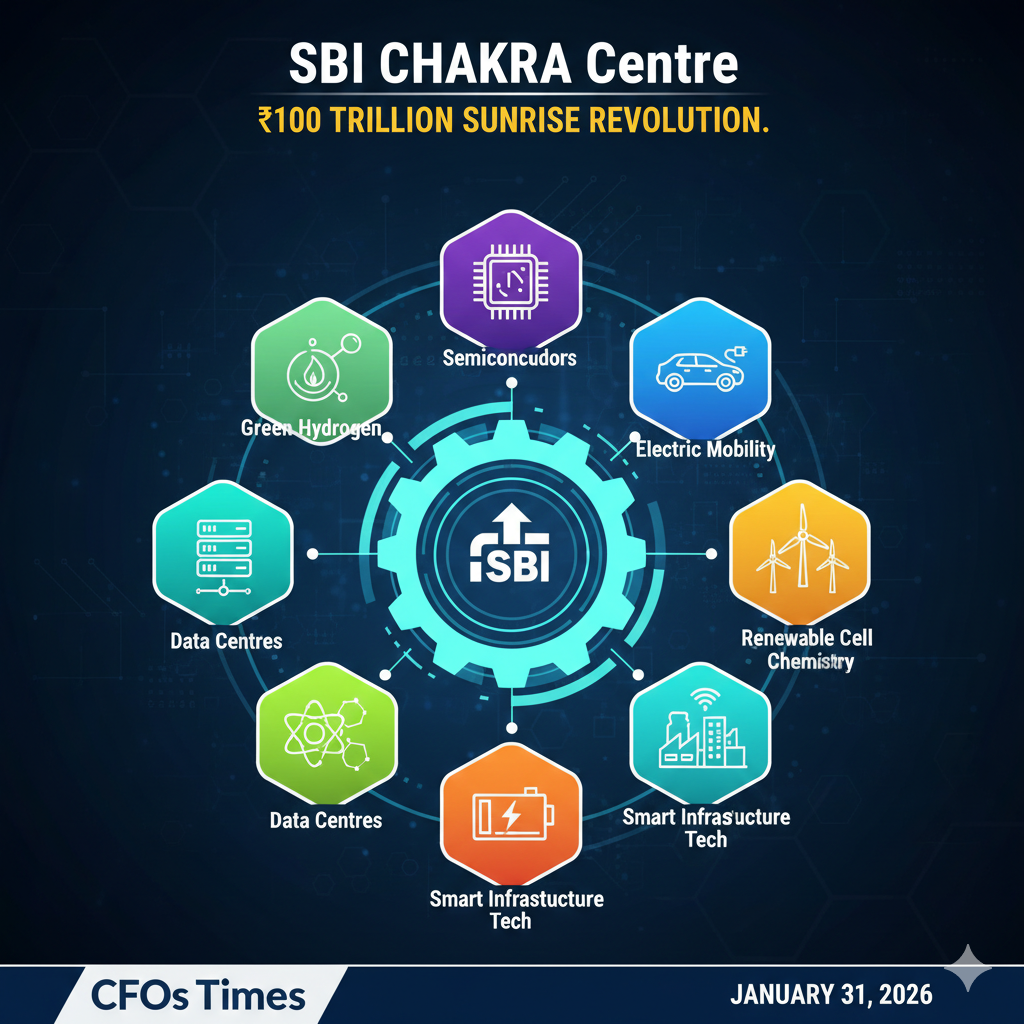
Table of Contents
1. SBI CHAKRA Centre: A New Paradigm for “Sunrise” Financing
The term “Sunrise Sectors” refers to industries that are in their infancy but are characterized by rapid growth, high innovation, and critical importance to future economic security. Traditionally, these sectors have struggled with bankability due to their high capex requirements and evolving technological risks.
The SBI CHAKRA Centre is established to solve these exact hurdles. By acting as a Knowledge-Led Platform, CHAKRA moves away from traditional balance-sheet lending toward Expertise-Based Appraisal.
The Core Mission of CHAKRA
- Directing Capital Flows: Responsibility-led channelling of funds into high-impact sustainability projects.
- Risk Assessment Innovation: Developing new frameworks to evaluate technologies like Green Hydrogen and Solid-State Batteries where historical data is sparse.
- Innovative Financing Structures: Moving beyond standard term loans to include mezzanine debt, risk capital, and coordinated ecosystem funding.
2. The Eight Pillars: Identified Sunrise Sectors
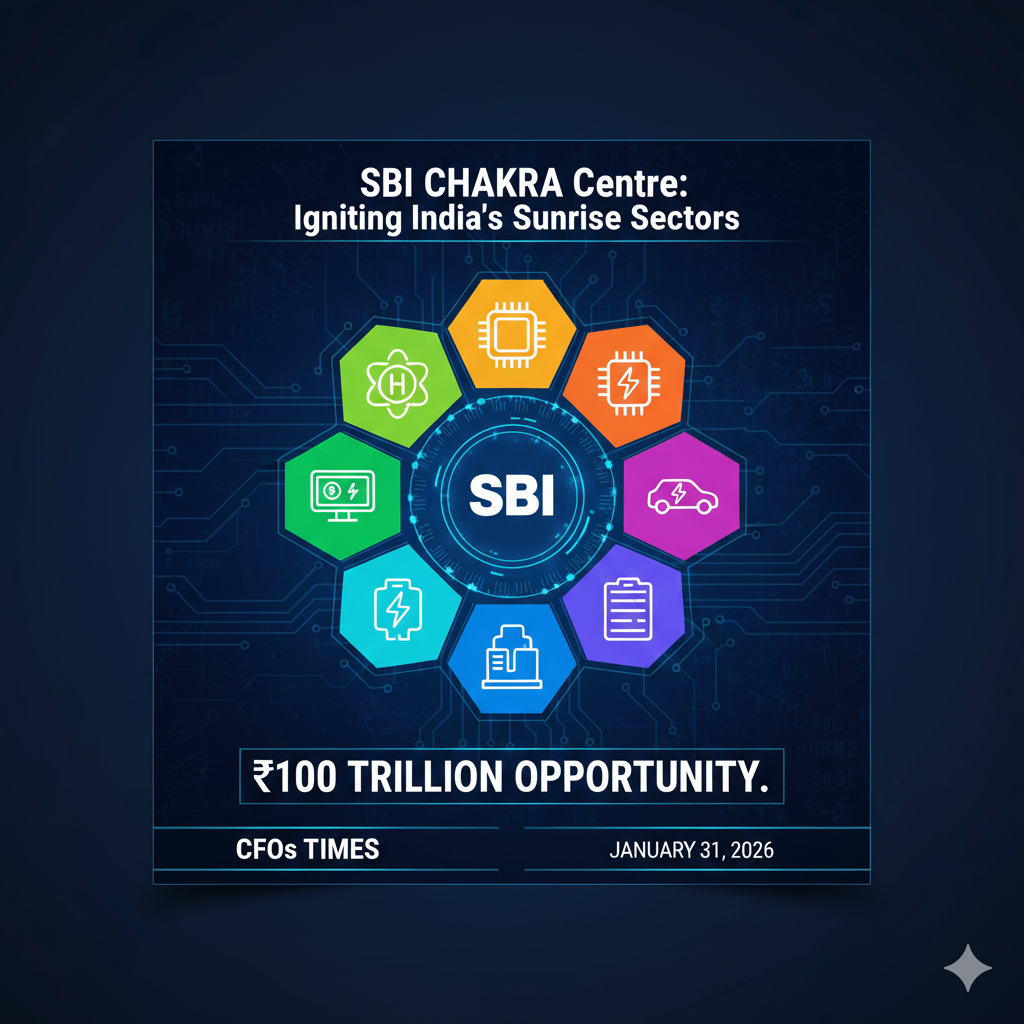
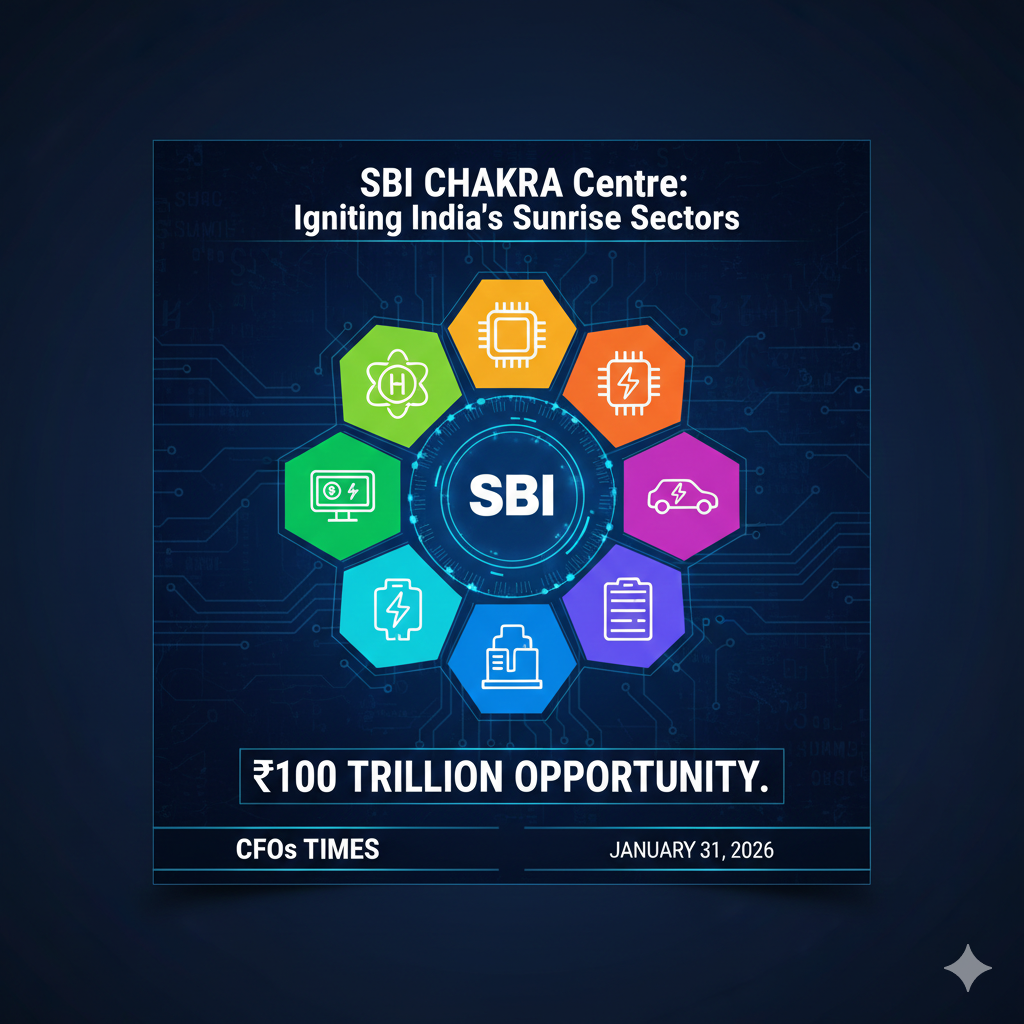
The SBI CHAKRA Centre has identified eight specific domains that will receive priority appraisal and funding. These sectors are projected to drive ₹20–22 Lakh Crore in debt opportunities over the next five years.
| Sector | Strategic Importance | Key Growth Drivers |
| Green Hydrogen | Energy Independence | National Green Hydrogen Mission, Export Potential |
| Semiconductors | Digital Sovereignty | India Semiconductor Mission (ISM), PLI Schemes |
| Electric Mobility | Decarbonization | EV Charging Infra, Battery Swapping Policy |
| Data Centres | Digital Economy | Data Localization Laws, 6G Rollout 2026 |
| Renewable Energy | Net Zero 2070 | Solar-Wind Hybrids, Pumped Hydro Storage |
| Advanced Cell Chemistry | Energy Storage | Battery Manufacturing, ACC-PLI Scheme |
| Smart Infrastructure | Urbanization | Smart Cities 2.0, Digital Twins, IoT Integration |
| Decarbonization Tech | Industrial ESG | Carbon Capture, Utilization, and Storage (CCUS) |
3. The “₹100 Trillion” Opportunity: A Financial Breakdown
During the launch, Chairman C.S. Setty emphasized that the sheer scale of investment—₹100 Lakh Crore—cannot be met by the Indian banking system alone. The SBI CHAKRA Centre is designed to facilitate a “Coordinated Ecosystem” approach.
Capital Mobilization Strategy
- Bank Debt: Anticipated to cover roughly 20-22% of the requirement.
- Corporate Cash Reserves: Indian conglomerates currently hold ₹13-14 Lakh Crore in cash balances. CHAKRA aims to provide the structures to deploy this as equity in sunrise projects.
- Multilateral Participation: Collaboration with the World Bank, AIIB, and Japanese lenders like MUFG and SMBC to provide long-tenure capital (15-30 years).
- Risk Capital: Exploring hybrid instruments that allow for a “cushion” before senior debt is triggered.
4. Strategic Impact on India’s Global Value Chain
The SBI CHAKRA Centre is a direct response to the “China Plus One” strategy and the global move toward localized, high-tech manufacturing. By establishing institutional capability to understand semiconductors and battery storage, SBI is ensuring that Indian manufacturing is not just about assembly, but about core technology ownership.
CFO Insight: The Secretary of DFS, M. Nagaraju, noted at the launch that PSU banks must now transition from “Balance Sheet Strengthening” to “Strategic Expansion.” CHAKRA is the blueprint for this transition.
5. How CHAKRA Will Function: The Workflow
Unlike a standard branch, the SBI CHAKRA Centre operates as a hybrid of a think-tank and a project finance hub.
- Knowledge Series & White Papers: Producing evidence-based research for policymakers and investors.
- Project Appraisal CoE: Specialized teams that understand the physics and chemistry of the projects they are funding.
- Policy Dialogue: Acting as a bridge between industry bodies (CII, FICCI) and the Ministry of Finance.
- Capacity Building: Training the wider banking ecosystem (other PSBs and NBFCs) on risk mitigation in new technologies.
6. Frequently Asked Questions (FAQs)
1. What is the SBI CHAKRA Centre?
It is a Centre of Excellence (CoE) launched by State Bank of India to provide specialized knowledge, risk assessment, and financing solutions for “Sunrise Sectors” critical to India’s 2047 economic goals.
2. Which sectors does CHAKRA focus on?
It focuses on eight key sectors: Green Hydrogen, Semiconductors, Electric Mobility, Data Centres, Renewable Energy, Advanced Cell Chemistry, Smart Infrastructure, and Decarbonization.
3. Why is it called “CHAKRA”?
The name symbolizes the “Wheel of Progress” and a coordinated ecosystem where knowledge, capital, and policy rotate in harmony to drive the economy forward.
4. Can private banks join the CHAKRA platform?
Yes. While led by SBI, Chairman Setty has stated the platform is open to private sector banks, global lenders, and multilateral agencies to co-finance large-scale projects.
5. How does this help a CFO?
For a CFO in a sunrise industry, the SBI CHAKRA Centre provides access to “Patient Capital” and a lender that actually understands the technical risks of their business, leading to faster approvals and better-structured debt.
Conclusion
The SBI CHAKRA Centre marks the beginning of the “Knowledge-Led Lending” era in Indian finance. By 2030, the success of India’s semiconductor and green energy ambitions will likely be traced back to the institutional frameworks built at this Centre. For the global investor and the Indian corporate leader, CHAKRA is the signal that the State Bank of India is ready to move beyond safe, traditional assets into the high-growth, technology-driven future of the nation.
Disclaimer
- Financial Disclaimer: This article on CFOs Times on the SBI CHAKRA Centre is for informational purposes only. Readers should consult official SBI Investor Relations for specific loan products and terms.
- Accuracy: This content is based on the official launch events of January 31, 2026, in Mumbai.
- Government Links: References to the Department of Financial Services and Viksit Bharat 2047 are provided for authoritative verification.

Dr. Dinesh Kumar Sharma is a CMA an award-winning Chief Financial Officer and Director of Finance with over 25 years of expertise in strategic planning and digital transformation. Recognized as a five-time CFO of the Year, he specializes in leveraging Generative AI and Microsoft Copilot to optimize financial forecasting and cost management. Dr. Sharma holds a Doctorate in Management (Finance) and has successfully scaled organizations from INR 1 billion to INR 7 billion. He is dedicated to providing transparent, data-driven insights for modern decision-makers at CFOs Times.