Introduction
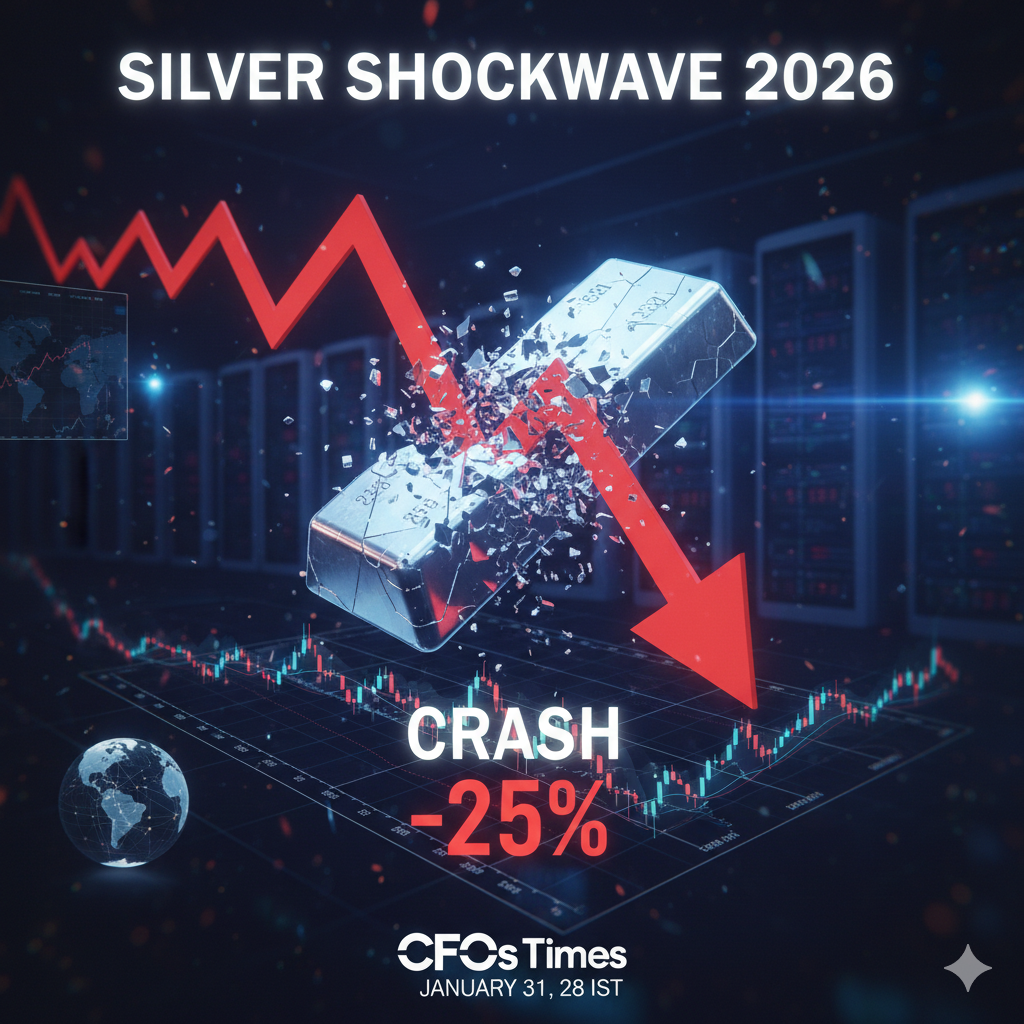
As of the final hour of trading on January 31, 2026, the global financial landscape has been upended by a “Black Swan” event in the commodities market. The Silver Meltdown 2026, characterized by a staggering 25% price drop in a single session, has left corporate treasuries reeling. From a historic peak of ₹4.10 lakh/kg just months ago to the current support level of ₹3.05 lakh/kg, the “white metal” is testing the resilience of finance leaders worldwide.
For the CFOs and controllers reading cfostimes.com, this volatility is not merely a market statistic—it is a direct hit to inventory valuations and long-term hedging strategies. However, in the 2026 economy, a crash is often the precursor to a “Supply-Side Reset.” By navigating this meltdown with transparency and strategic sobriety, firms can secure a significant competitive advantage before the Union Budget 2026 announcements tomorrow.

1. The Silver Meltdown 2026: Decoding the “Flash Crash” Mechanics
Understanding the “Why” behind the crash is essential for regulatory compliance and board-level reporting.
The Role of Agentic AI and Algorithmic Triggers
In 2026, over 90% of commodity trading is managed by autonomous agents. Once the critical support level of ₹3.50 lakh/kg was breached at 11:30 AM today, a cascade of automated “sell-bots” accelerated the liquidation. This wasn’t just human panic; it was a systemic rebalancing triggered by the U.S. Treasury’s latest yield projections.
The Resurgent U.S. Dollar (USD) and Global Trade Fragmentation
As geopolitical tensions simmer between the U.S. and EU over the India trade deal, the Dollar has emerged as the ultimate “safe haven.” The inverted relationship between a strong USD and dollar-denominated metals like silver is the primary driver behind today’s Silver Meltdown 2026.
2. CFO Strategy: Managing Inventory and Hedge Ratios
A 25% drop in a core industrial asset requires immediate accounting interventions to comply with IFRS and GAAP standards.
Inventory Write-Downs (Lower of Cost or Market)
CFOs must immediately assess the carrying value of physical silver stockpiles. If the market value (now ₹3.05 lakh/kg) is lower than the purchase price, a non-cash impairment charge may be necessary. Transparency in these disclosures is a key trust signal for investors.
Re-Hedging: The “Buy the Dip” Opportunity
For industries such as Solar PV manufacturing and EV battery production, silver is a non-negotiable input. The Silver Meltdown 2026 offers a rare window to lock in FY 2026-27 production costs at a massive discount.
| Asset | 2025 Peak | Current (Jan 31, 2026) | % Correction | Recommended CFO Action |
| Silver (Industrial) | ₹4.10 Lakh/kg | ₹3.05 Lakh/kg | -25.6% | Strategic Accumulation |
| Gold (Treasury) | ₹1.82 Lakh/10g | ₹1.58 Lakh/10g | -13.2% | Diversification/Hold |
| Copper (LME) | $11,400/MT | $10,100/MT | -11.4% | Monitor for Industrial Stability |
3. The “Green Supercycle” Resilience
Despite the Silver Meltdown 2026, the long-term fundamentals of silver as a “Green Metal” remain intact. The UNCTAD 2026 Trade Report highlights that global demand for photovoltaics and electronics will grow by 14% annually through 2030. The current crash is a liquidity event, not a demand collapse.
Key takeaway for 2026 Leaders:
“Don’t confuse a technical liquidation with a fundamental shift. The silver you buy today at ₹3 lakh is the same silver your competitors will scramble for at ₹4 lakh when the green energy mandate intensifies in Q3.”
Conclusion
The Silver Meltdown 2026 marks a volatile end to the first month of the year. For the office of the CFO, it serves as a high-stakes stress test of their commodity risk framework. By acknowledging the crash, re-evaluating hedges, and maintaining a “glass-box” approach to financial reporting, your organization can emerge from this meltdown with a leaner, more resilient balance sheet. Tomorrow’s Union Budget 2026 will likely provide the next catalyst; make sure your treasury is positioned to catch the rebound.
FAQs: Navigating the 2026 Silver Crash
1. Why did the Silver Meltdown 2026 happen today?
A confluence of high U.S. interest rates, a strengthening Dollar, and automated AI trading triggers led to a massive institutional sell-off ahead of the India Budget.
2. Is this crash temporary or a long-term trend?
Most analysts view this as a “healthy correction” in an overheated market. Industrial demand for silver in 2026 remains at record levels, suggesting a likely “V-shaped” recovery once the SEBI market volatility cools.
3. How does this impact EV and Solar stocks?
Lower silver prices improve the margins for battery and panel manufacturers. While their stock might dip initially due to inventory write-downs, their long-term profitability outlook is actually enhanced by this crash.
4. Should corporate treasuries liquidate their silver holdings?
Panic selling at a 25% discount is rarely the optimal strategy. CFOs should instead look at “Dollar Cost Averaging” their hedges and re-balancing their metal-to-cash ratios.
5. Where can I track official import duty changes for silver?
Always consult the Central Board of Indirect Taxes and Customs (CBIC) for the latest duty structures following the Union Budget.
Disclaimer
1. Informational Purposes Only All content published on cfostimes.com, including articles, charts, and market analysis regarding the Silver Meltdown 2026 or any other financial event, is provided for informational and educational purposes only. It does not constitute professional financial, investment, legal, or tax advice.
2. No Fiduciary Relationship Your use of this website does not create a consultant-client or fiduciary relationship between you and cfostimes.com. While we strive for 100% accuracy, the fast-moving nature of 2026 global markets means information may become outdated or contain errors. We strongly recommend consulting with a certified financial planner or qualified professional before making any significant fiscal decisions.
3. Risk Warning Investing in commodities, equities, or digital assets involves high risk. Past performance, such as the 2024-2025 silver rally, is not indicative of future results. cfostimes.com and its authors shall not be held liable for any financial losses or damages resulting from the use of this information.
4. Third-Party Links & AdSense Disclosure This site uses Google AdSense and contains links to high-authority third-party sites (e.g., RBI, SEC). We do not endorse or assume responsibility for the content or practices of these external sites. Third-party vendors, including Google, use cookies to serve ads based on your prior visits to this or other websites.

Dr. Dinesh Kumar Sharma is a CMA an award-winning Chief Financial Officer and Director of Finance with over 25 years of expertise in strategic planning and digital transformation. Recognized as a five-time CFO of the Year, he specializes in leveraging Generative AI and Microsoft Copilot to optimize financial forecasting and cost management. Dr. Sharma holds a Doctorate in Management (Finance) and has successfully scaled organizations from INR 1 billion to INR 7 billion. He is dedicated to providing transparent, data-driven insights for modern decision-makers at CFOs Times.