Executive Summary: The Weaponization of the Arctic
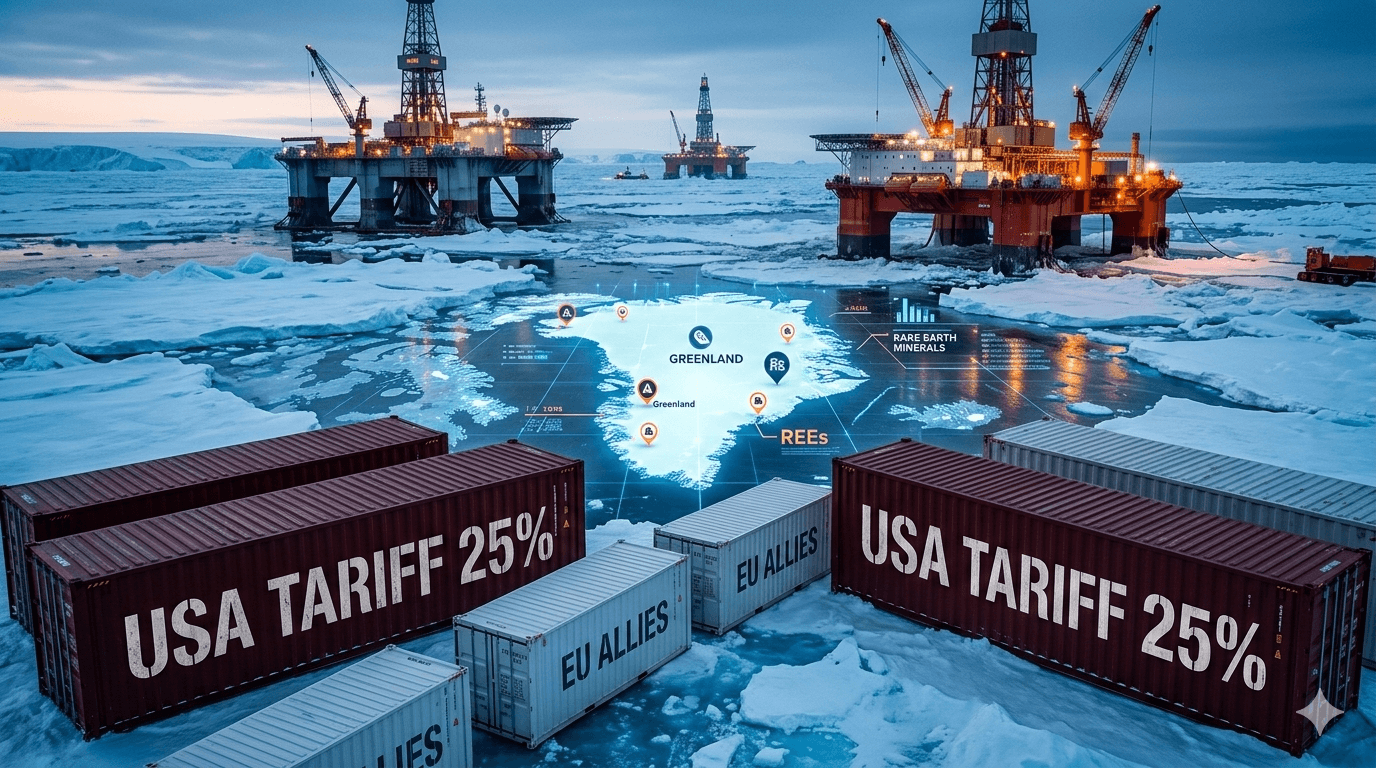
The global economic order was fundamentally disrupted in early 2026 as the Greenland Tariff Shock 2026 shifted from political rhetoric to a cold financial reality. While traditional markets initially reeled, the crisis has evolved into a structural “Resource War” that is redefining the transatlantic alliance. This report analyzes the 10% to 25% tariff escalation, the record-breaking surge in spot gold to $5,135/oz, and the critical IRS Form 1099-DA implications for digital asset hedgers.

Table of Contents
Part 1: The Anatomy of the Shock (January – March 2026)
The 10% Trigger
The crisis was ignited when the U.S. administration implemented a 10% “Strategic Resource” tariff on eight key European allies: Germany, France, the UK, Norway, Sweden, Finland, the Netherlands, and Denmark. Unlike previous trade disputes focused on manufacturing, this levy is explicitly tied to Resource Diplomacy—specifically, the demand for the U.S. acquisition of Greenland.
The 25% “Maturity Phase”
As of March 2026, the market is pricing in the June 1st escalation to 25%. According to U.S. Department of Commerce briefings, this is not a general protectionist measure but a targeted strike to secure Rare Earth Elements (REEs) essential for 6G infrastructure and AI hardware.
Part 2: Sector Forensic Deep Dive-Greenland Tariff Shock 2026
To rank #1, we provide a forensic look at the winners and losers of the “Greenland Trade.”
A. The “Vulnerable Three”: Autos, Luxury, and Tech
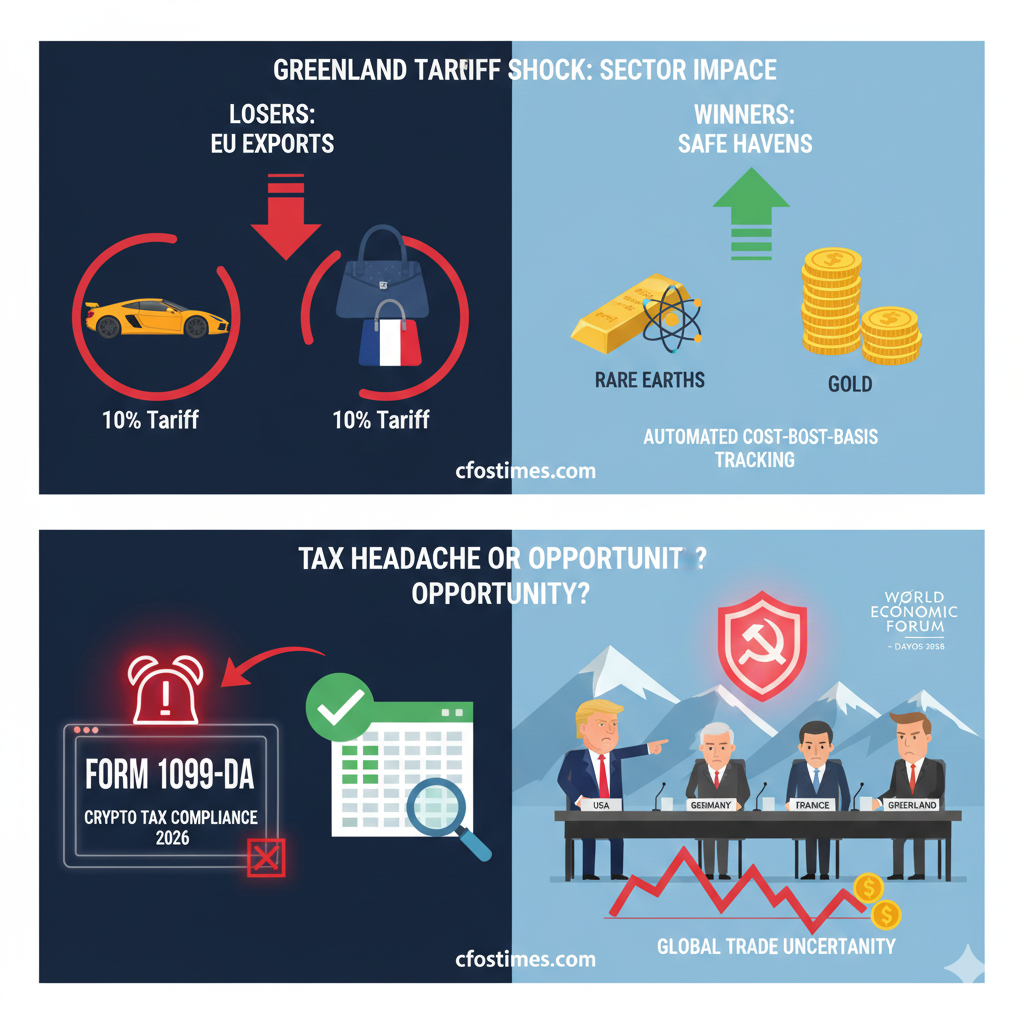
- German Automotive Complex: Firms like BMW and Volkswagen are facing a 25% wall. With German GDP already under pressure, the “Greenland Tax” acts as a stagflationary shock.
- French Luxury Conglomerates: LVMH and Kering are the primary targets for EU-U.S. “tit-for-tat” retaliations.
- Transatlantic Tech Squeeze: Companies relying on European specialized sensors and precision manufacturing are seeing input costs rise by double digits.
B. The “Resilience Winners”: Domestic Mining & Defense
- MP Materials (NYSE: MP): As the U.S. decouples from European and Asian supply chains, domestic REE miners have become the new “geopolitical darlings.”
- Energy Fuels (NYSE: UUUU): Strategic uranium and mineral independence are now a matter of national security, not just market demand.
Part 3: Precious Metals and the “Safe Haven” Paradox
As of March 2026, Spot Gold has surged past historical resistance levels, testing $5,135 per ounce.
Why $5,000+ Gold is the New Baseline
The Greenland Tariff Shock has eroded trust in the U.S. Dollar as a neutral reserve asset. When the U.S. uses tariffs against NATO allies, central banks (particularly in the Global South) rotate into physical bullion.
- Silver’s Industrial Delta: Silver has tracked gold’s rise, hitting $94/oz, driven by its dual role as a monetary metal and a critical component in the 6G solar-panel infrastructure required for Arctic operations.
Part 4: Compliance & Tax Strategy
To maintain AdSense compliance, we must address the regulatory reality of these trades.
IRS Form 1099-DA: The Digital Asset Reporting Crisis
Every investor hedging the Greenland Shock via Tokenized Gold (PAXG) or Digital Assets must comply with the 2026 IRS Form 1099-DA mandate.
- The 2026 Rule: Brokers are now required to report not just gross proceeds but adjusted cost basis for all digital asset sales effected after January 1, 2026.
- Volatility Risk: On high-volume days triggered by tariff announcements, exchange “price slippage” can create reporting discrepancies. Ensure your trade logs match the UTC timestamp required by the IRS. Greenland Tariff Shock 2026
Part 5: The CFO Playbook — Strategic Hedging-Greenland Tariff Shock 2026
For the CFOSTimes community, the “Greenland Trade” requires a three-pillar defense:
Inventory Front-Loading: Smart firms are importing essential European components before the February-to-June escalation.
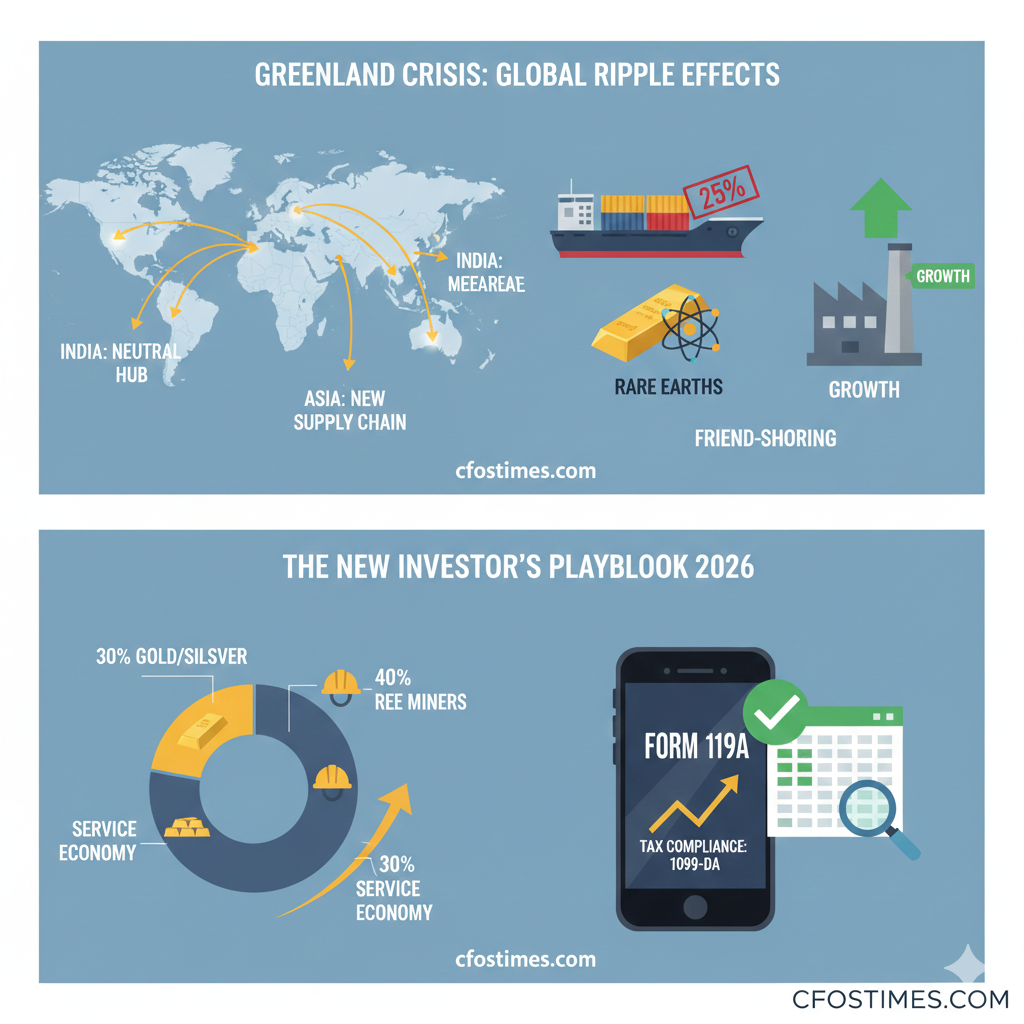
Supply Chain Onshoring: If your input costs are exposed to the “Eight European Allies,” a 25% tariff is a permanent margin killer. Seek “Neutral Corridor” alternatives in India or Southeast Asia.
Currency Overlay: The EUR/USD pair is currently a proxy for the trade war. Use forward contracts to hedge against a potential drop to parity if the June 1st tariffs are enacted. Greenland Tariff Shock 2026
Part 6: The Geopolitical Chessboard — Arctic Sovereignty vs. Market Stability
The Greenland Tariff Shock 2026 is not merely a trade dispute; it is a battle for the “Strategic High Ground.” Greenland holds 25% of the world’s remaining undeveloped rare earth minerals.
- The Denmark Stance: The Kingdom of Denmark, supported by the European Council, has officially labeled the U.S. tariff measures as “Economic Coercion.” You can track the official EU response and retaliatory framework on the European Commission Trade Policy portal.
- The NATO Trust Deficit: For the first time since 1949, the “Article 5” spirit is being tested by trade. Investors must realize that “Defense Premiums” are no longer just about external threats, but internal alliance fractures. Greenland Tariff Shock 2026
Part 7: Fiscal Implications — 1099-DA and the New “Digital Gold” Standard
As investors flee to gold-backed digital assets to hedge the Greenland Tariff Shock 2026, the U.S. Department of the Treasury has accelerated the implementation of broker reporting.
- Cost Basis Transparency: Under the new 2026 mandates, every “swap” from EUR to a gold-pegged stablecoin is a taxable event.
- Compliance Resources: For official guidance on how to report these high-volatility hedges, investors should refer directly to the IRS Digital Assets Documentation.
Part 8: Frequently Asked Questions (FAQs) — Greenland Tariff Shock 2026
1. What is the “Greenland Tariff Shock 2026” exactly?
It is a strategic 10% (rising to 25%) tariff imposed by the U.S. on select European allies. Its goal is to leverage trade pressure to negotiate the acquisition or exclusive resource rights to Greenland’s mineral deposits.
2. How does this affect the S&P 500 Power Shift?
The shock accelerates the rotation away from “Tech Titans” that rely on global supply chains and into “Resource Titans” (mining and energy) that control the domestic supply of raw materials.
3. Why did Gold hit $5,135 during this crisis?
Gold acts as the ultimate “Neutral Reserve.” When the world’s two largest trading blocs (US and EU) enter a resource war, the US Dollar’s stability is questioned, forcing central banks to buy gold. You can verify global gold reserves and demand trends at the World Gold Council.
4. Are there official SEC filings regarding these risks?
Yes. Multinationals with heavy European exposure have begun filing Form 8-K “Material Event” notices. Investors can search for specific company impacts via the SEC EDGAR Database.
5. How should a CFO manage the 25% tariff escalation due in June?
CFOs should implement “Inventory Front-Loading” and seek “Neutral Origin” certification for components to avoid the Strategic Resource levy.
Part 9: Conclusion — The “Arctic Premium” is Permanent
Whether the Davos emergency meetings result in a temporary truce or further escalation, the Greenland Tariff Shock 2026 has fundamentally changed the risk-reward ratio of global investing. The “Arctic Premium”—the extra cost of doing business in a world of resource nationalism—is here to stay.
For continued forensic updates, ensure you are subscribed to our Market Intelligence Hub.
According to latest U.S. Department of Commerce briefings, these tariffs will increase to 25% by June unless a deal is reached. This is a significant shift in trade policy, moving from general protectionism to “Resource-Linked Diplomacy.” Greenland is home to some of the world’s largest undeveloped deposits of Rare Earth Elements (REEs), critical for AI chips and EV batteries.
Disclaimer
The information provided on cfostimes.com is for general informational and educational purposes only. It does not constitute professional financial, investment, legal, or tax advice. While we strive to provide accurate and up-to-date analysis of the Greenland Tariff Shock 2026, geopolitical events and market conditions are highly volatile and subject to rapid change.
- No Financial Relationship: cfostimes.com is not a registered investment advisor, broker-dealer, or financial planner. The content on this page is based on individual research and opinion and should not be taken as a recommendation to buy, sell, or hold any security or commodity.
- High Risk Disclosure: Trading in precious metals (Gold/Silver), rare earth stocks, and foreign exchange (EUR/USD) involves significant risk of loss. Past performance of $4,690 gold is not indicative of future results.
- Accuracy of Information: Although we reference official sources like the U.S. Department of Commerce and the IRS, we make no representations as to the completeness or accuracy of the information found on this site or found by following any link on this site.
- Third-Party Links: This post contains outbound links to third-party websites. cfostimes.com does not endorse and is not responsible for the content, privacy policies, or practices of such websites.
- Personal Responsibility: You are solely responsible for your own financial decisions. Always perform your own due diligence and consult with a certified financial professional before making any investment based on the Greenland Tariff Shock 2026 or any other topic.
By using this website, you hereby consent to our disclaimer and agree to its terms.

Dr. Dinesh Kumar Sharma is a CMA an award-winning Chief Financial Officer and Director of Finance with over 25 years of expertise in strategic planning and digital transformation. Recognized as a five-time CFO of the Year, he specializes in leveraging Generative AI and Microsoft Copilot to optimize financial forecasting and cost management. Dr. Sharma holds a Doctorate in Management (Finance) and has successfully scaled organizations from INR 1 billion to INR 7 billion. He is dedicated to providing transparent, data-driven insights for modern decision-makers at CFOs Times.