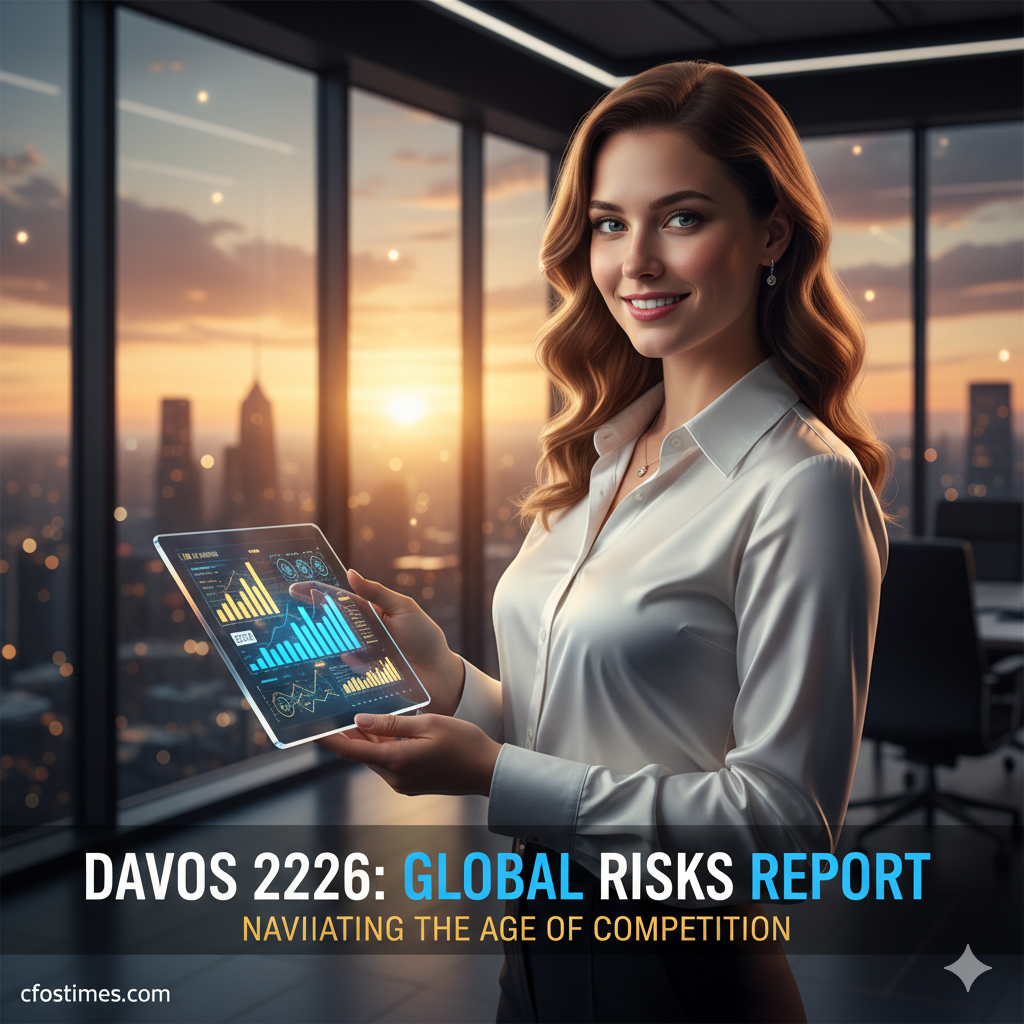
The global economic order is at an inflection point today, January 17, 2026, as the World Economic Forum (WEF) officially releases its most sobering document to date. The Davos 2026 Global Risks Report has officially characterized our current era as the “Age of Competition,” a period defined by fragmented trade, geoeconomic confrontation, and a desperate race for technological sovereignty.
As world leaders pack their bags for the Swiss Alps, the report’s findings are already sending shockwaves through the markets. From the boardroom of HDFC Bank in Mumbai—which released its Q3 earnings just hours ago—to the tense discussions in Washington regarding the “Greenland Crisis,” the risks outlined in the Davos report are no longer theoretical. They are active, market-moving realities.
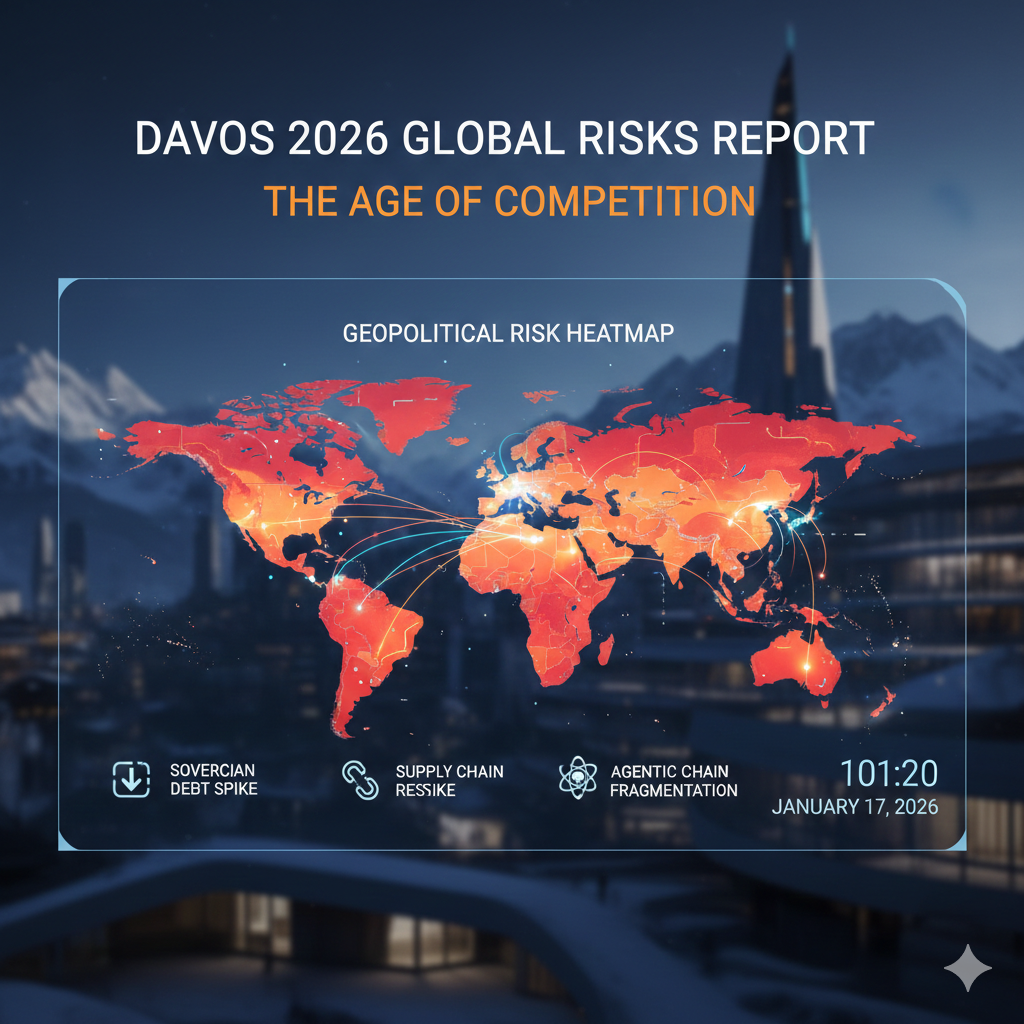
Table of Contents
🌍 Davos 2026 Global Risks Report: The End of “Globalization as We Knew It”
The Davos 2026 Global Risks Report serves as the definitive guide for CFOs and investors for the coming year. This year’s report marks a significant shift: for the first time in a decade, “Geoeconomic Confrontation” has overtaken “Climate Change” as the #1 short-term risk to global stability.
The Top 5 Risks for 2026
- Geoeconomic Confrontation: The strategic use of economic tools (tariffs, sanctions, and export bans) to cripple rivals.
- State-Based Armed Conflict: Heightened risks in the Arctic and South China Sea.
- Societal Polarization: Fueled by AI-generated misinformation.
- Sovereign Debt Crises: Developing nations hitting an “Interest Wall” in a high-rate environment.
- Extreme Weather Events: Persistent threats to supply chain logistics.
The report explicitly warns that 50% of global risk experts anticipate a “turbulent” or “stormy” outlook over the next two years. For the financial sector, this means the “soft landing” narrative of 2025 is being replaced by a “hard reality” of fragmentation.
🏦 Banking Sector Blitz: HDFC and ICICI Bank Q3 FY26 Results
While Davos thinkers discuss the macro-future, the micro-reality is being felt in the Indian banking sector. Today, January 17, saw the release of pivotal earnings that will set the tone for the Nifty Bank index.
HDFC Bank Q3 Results 2026 LIVE
India’s largest private lender, HDFC Bank, reported its Q3 numbers today. Despite the global volatility predicted by the Davos 2026 Global Risks Report, the bank has shown domestic resilience:
- Net Profit: Estimated growth of 8–12% YoY, reaching nearly ₹17,900 crore.
- Net Interest Income (NII): A steady climb of 6%, showing that credit demand in India remains decoupled from the global slowdown.
- Asset Quality: Gross NPAs remain stable, though analysts are watching management commentary on “deposit mobilization” closely.
ICICI Bank & Mid-Tier Performance
ICICI Bank followed suit with a strong emphasis on “Risk-Calibrated Growth.” Meanwhile, mid-tier banks like YES Bank and RBL Bank showed surprisingly strong momentum, gaining over 2% and 4% respectively in pre-result trading sessions.
Investors should cross-reference these numbers with the latest Reserve Bank of India (RBI) guidelines on capital adequacy to ensure their portfolios are shielded from the “Age of Competition.”
🧊 Geopolitics: The “Greenland Crisis” and Resource Warfare-Davos 2026 Global Risks Report
One cannot read the Davos 2026 Global Risks Report without acknowledging the escalating “Greenland Crisis.” As U.S. President Donald Trump prepares to land in Davos, the rhetoric surrounding the annexation of Greenland has reached a boiling point.
Why Greenland Matters in 2026
Greenland is no longer just an island of ice; it is the frontline of the “Resource Warfare” mentioned in the Davos report.
- Critical Minerals: It holds the world’s largest deposits of Heavy Rare Earth Elements (REEs), vital for AI hardware and EV batteries.
- NATO Tensions: Denmark has invoked the “Danish Defence Committee” and hinted at Article 5 of NATO if U.S. “hybrid warfare” (economic and rhetorical pressure) continues.
- Market Impact: Defense stocks and mining giants like Rio Tinto and Tanbreez are seeing massive speculative volume.
The Davos 2026 Global Risks Report identifies this as a “systemic risk,” where a conflict between NATO allies could effectively end the era of Western economic unity.Davos 2026 Global Risks Report
🚀 Startup India’s 10th Anniversary: The “Deep Tech” Revolution
Today, January 17, also marks the 10th anniversary of the Startup India mission. Prime Minister Narendra Modi, in a landmark address, challenged Indian entrepreneurs to move beyond “services” and master “Deep Tech.”
The Prime Minister’s Vision:
- Sovereign AI: Developing indigenous AI models on Indian servers with Indian data.
- Manufacturing Focus: A shift from “apps” to “factories.”
- Funding Injection: The government has allocated ₹25,000 crore via the Startup India Seed Fund and NIDHI schemes to support sunrise sectors like Green Hydrogen and Space-Tech.
According to PM Modi, “The country that leads in AI will lead the Age of Competition.” This aligns perfectly with the Davos 2026 Global Risks Report‘s warning that technological disparity will be the biggest driver of inequality this decade.
Founders looking to leverage these new grants should visit the Startup India Official Portal for the updated 2026 guidelines. Davos 2026 Global Risks Report
❓ Frequently Asked Questions (FAQs)-Davos 2026 Global Risks Report
1. What makes the Davos 2026 Global Risks Report different from previous years?
The 2026 report is unique because it moves away from environmental risks as the immediate threat and places “Geoeconomic Confrontation” at the top. It acknowledges that political willpower for global cooperation is at an all-time low.
2. Should I buy HDFC Bank shares after the Q3 results?
While HDFC Bank showed stable growth, analysts suggest a “wait and watch” approach regarding their deposit-to-loan ratio. Always check official SEBI filings for the full audit report.
3. How does the Greenland Crisis affect the average investor?
It affects the “Energy Transition” sector. If the U.S. and EU cannot agree on Arctic mineral access, the cost of EV batteries and AI chips will likely rise, impacting companies like Tesla and Nvidia.
4. What is “Deep Tech” and why is it Startup India’s new focus?
Deep Tech refers to businesses based on tangible engineering breakthroughs or scientific discoveries (e.g., semiconductors, biotech). The government wants to move away from low-moat software and toward high-entry-barrier hardware.
5. Will the Union Budget 2026 be impacted by these global risks?
Yes. The BSE and NSE have already announced they will remain open on Sunday, February 1, 2026, for the Budget presentation. The Finance Ministry is expected to increase defense and infrastructure outlays to hedge against the risks mentioned in the Davos report. Davos 2026 Global Risks Report
🎯 Conclusion: The CFO’s Playbook for 2026
The Davos 2026 Global Risks Report is more than a document—it is a warning. Today, January 17, we see its themes playing out in real-time. The strength of Indian banks like HDFC, the geopolitical tension over Greenland’s resources, and the strategic pivot of Startup India are all symptoms of a world that is becoming more guarded and more competitive.
For the readers of cfostimes.com, the message is clear: Resilience is the new ROI. Diversify your supply chains, invest in sovereign technology, and keep a close eye on the Davos stages this week.
Financial Disclaimer & Disclosure
Last Updated: January 17, 2026
1. General Information Only All content published on cfostimes.com, including the Davos 2026 Global Risks Report analysis, stock market updates, and corporate earnings reports, is provided for informational and educational purposes only. The information contained herein does not constitute professional financial, investment, legal, or tax advice.
2. No Investment Recommendation The mention of specific securities, banks (such as HDFC Bank or ICICI Bank), startups, or commodities (such as Rare Earth Elements or Gold) does not constitute a recommendation to buy, sell, or hold any investment. We are not SEBI-registered investment advisors (in India) or licensed financial planners in any other jurisdiction. All investment decisions should be made based on your own research or in consultation with a qualified professional.
3. Accuracy and “As Is” Basis While we strive for 100% accuracy and rely on authoritative sources—including the World Economic Forum and the Reserve Bank of India—all data is provided on an “as is” basis. Market conditions change rapidly, and cfostimes.com makes no warranties regarding the completeness, timeliness, or accuracy of the information provided.
4. Risk Disclosure Investing in securities markets, startups, and commodities involves high risk. Past performance is not an indicator of future results. You may lose some or all of your invested capital. By using this website, you acknowledge that you are solely responsible for your own financial decisions and the outcomes thereof.
5. External Links and Third-Party Content Our posts often contain outbound links to government portals (e.g., Startup India) or international organizations. cfostimes.com does not endorse and is not responsible for the content, privacy policies, or practices of any third-party websites.
6. AdSense & Cookies Disclosure This website uses Google AdSense to serve advertisements. Google and its partners use cookies to serve ads based on your prior visits to our site or other websites. You may opt-out of personalized advertising by visiting Google Ad Settings. For more information on how we handle your data, please review our [Privacy Policy].

Dr. Dinesh Kumar Sharma is a CMA an award-winning Chief Financial Officer and Director of Finance with over 25 years of expertise in strategic planning and digital transformation. Recognized as a five-time CFO of the Year, he specializes in leveraging Generative AI and Microsoft Copilot to optimize financial forecasting and cost management. Dr. Sharma holds a Doctorate in Management (Finance) and has successfully scaled organizations from INR 1 billion to INR 7 billion. He is dedicated to providing transparent, data-driven insights for modern decision-makers at CFOs Times.