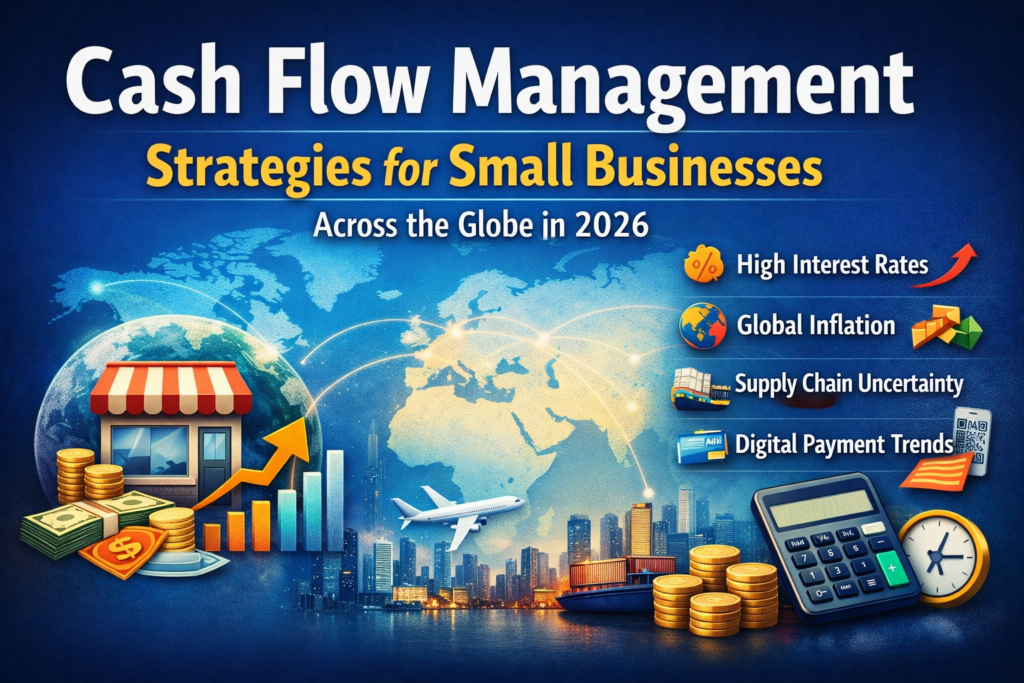
Cash flow management has always been critical for small businesses, but 2026 presents a fundamentally different financial environment. Higher interest rates in many economies have increased borrowing costs, global inflation continues to pressure margins, and digital payments now dominate how money moves across borders. At the same time, geopolitical tensions and ongoing supply chain uncertainty make cash inflows and outflows harder to predict.
Unlike large enterprises with access to capital markets and deep reserves, small businesses are far more vulnerable to short-term cash gaps. A delayed customer payment, a sudden increase in supplier costs, or currency volatility can quickly disrupt operations, payroll, and growth plans.
This is why Cash Flow Management Strategies for Small Businesses Across the Globe in 2026 must evolve beyond basic bookkeeping. Small businesses increasingly require CFO-level insights—forecasting, scenario planning, and strategic decision-making—to stay resilient. Platforms like cfostimes.com focus on helping business owners think like finance leaders, treating cash flow not as an afterthought but as a core strategic function.
Understanding Modern Cash Flow
To manage cash effectively, small business owners must first understand what cash flow truly means. Modern cash flow is typically divided into three categories:
- Operating cash flow: money generated or used by day-to-day business activities.
- Investing cash flow: cash spent on or received from long-term assets like equipment or technology.
- Financing cash flow: funds raised or repaid through loans, equity, or owner contributions.
A common mistake is confusing profit with cash. A business may show a healthy profit on paper while struggling to pay salaries because customers haven’t paid yet. For example, issuing a large invoice increases profit immediately, but cash only arrives when the client pays.
In 2026, the key shift is toward real-time cash visibility. Cloud accounting tools allow business owners to see their cash position daily rather than monthly. This visibility empowers faster decisions, reduces surprises, and turns cash flow into a proactive management tool instead of a reactive problem.
Building Accurate Forecasts–Cash Flow Management Strategies
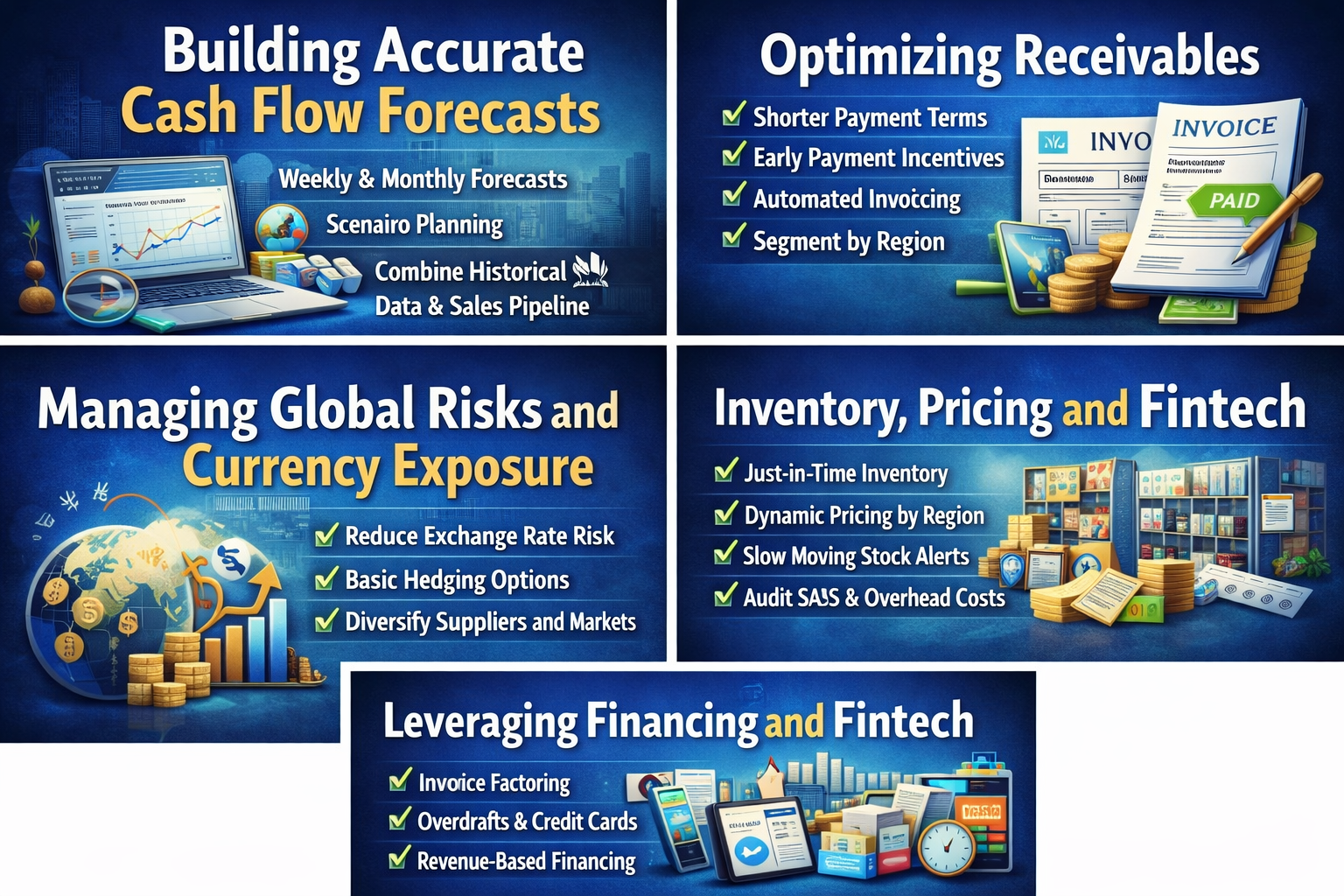
Forecasting is the backbone of effective cash flow management. In 2026, small businesses can no longer rely on annual budgets alone. Instead, weekly and monthly cash flow forecasts provide the flexibility needed to respond to changing conditions.

A strong forecast combines:
- Historical data (past inflows and expenses)
- Current sales pipeline (expected invoices)
- Known obligations (payroll, rent, taxes, supplier payments)
Scenario planning is especially important. Businesses should model:
- Best-case scenarios (faster collections, higher sales)
- Base-case scenarios (expected performance)
- Worst-case scenarios (delays, cost increases)
Affordable tools such as Xero, QuickBooks, Zoho, and cash-flow add-ons make this accessible even for very small businesses. The goal is not perfection, but visibility and preparedness.
Optimizing Receivables–Cash Flow Management Strategies
The fastest way to improve cash flow is to get paid faster. Optimizing receivables means reducing the time between delivering value and receiving cash.
Key tactics include:
- Setting shorter payment terms and clearly communicating them upfront
- Offering small discounts for early payment
- Applying late payment penalties, where legally allowed
- Using automated invoicing and payment reminders
Regional payment preferences matter greatly in 2026.
- US and EU clients often prefer cards, ACH transfers, and open-banking payments
- Asia, Africa, and Latin America increasingly rely on mobile wallets, QR payments, and local gateways
Segmenting customers by payment behavior allows businesses to focus collection efforts where they matter most, improving predictability and reducing stress.
Controlling Payables Without Damaging Relationships–Cash Flow Management Strategies
Managing payables is about balance, not delay at all costs. Smart businesses negotiate 30- to 60-day payment terms with suppliers while maintaining trust.
Best practices include:
- Prioritizing critical payments like payroll, taxes, and core suppliers
- Avoiding unnecessary early payments unless discounts justify them
- Scheduling batch payments to improve predictability
Virtual cards and scheduled bank transfers help control timing while maintaining professionalism. The objective is to protect cash without harming supplier relationships, which are vital in uncertain markets.
Inventory, Pricing, and Cost Strategies
Inventory ties up cash, making it a major focus area in 2026. Many businesses are moving away from “stock everything” toward data-driven and just-in-time inventory models.
Tracking slow-moving items and clearing them through promotions releases trapped cash. Pricing strategies must also adapt globally, factoring in demand, cost structures, and currency movements.
Cost control remains essential. Businesses should audit subscriptions, SaaS tools, and overhead at least twice a year. Small, recurring expenses often drain more cash than large, visible costs.
Managing Global Risks and Currency Exposure: Cash Flow Management Strategies
Currency fluctuations can quietly erode margins. A strong sales month can turn unprofitable once converted into the home currency.
Small businesses can reduce exposure through:
- Pricing in stable currencies
- Natural hedging (matching income and expenses in the same currency)
- Simple forward contracts via banks or fintech providers
Diversifying suppliers and markets reduces geopolitical and logistics risks. In some industries, trade credit insurance adds another layer of protection against customer defaults.
Leveraging Financing and Fintech–Cash Flow Management Strategies
Financing can stabilize cash flow when used strategically. Common options include:
- Invoice factoring
- Revenue-based financing
- Overdrafts and business credit cards
Each option has different cost and risk profiles. In 2026, fintech plays a growing role through instant settlements, embedded lending, and AI-based risk scoring.
The key principle is discipline: debt should fund growth with measurable ROI, not mask structural cash flow problems.
Building a Cash Culture With Your Team: Cash Flow Management Strategies
Cash flow is not just a finance issue. Sales discounts, procurement choices, and project delays all affect liquidity.
Educating teams on cash impact and tracking KPIs such as:
- Days Sales Outstanding (DSO)
- Days Payable Outstanding (DPO)
- Cash Conversion Cycle (CCC)
Monthly cash review meetings and dashboards ensure visibility at both owner and CFO levels. Cash Flow Management Strategies
Regional Best Practices–Cash Flow Management Strategies
Cash flow strategies must adapt to local realities:
- North America & Europe: cards, ACH, open banking
- Asia: digital wallets and super-apps
- Africa: mobile money ecosystems
- Middle East & Latin America: mixed cash, card, and fintech environments
Understanding local payment culture and regulations significantly improves cash predictability.
Practical 90-Day Action Plan–Cash Flow Management Strategies
Weeks 1–4: Map cash flows, build forecasts, review invoices and payables
Weeks 5–8: Renegotiate terms, add faster payment methods, cut non-essential costs
Weeks 9–12: Automate reporting, test financing options, train teams, build dashboards
Conclusion: Cash Flow Management Strategies
Strong cash flow in 2026 depends on visibility, discipline, flexibility, and global awareness. Businesses that treat cash flow as a strategic, CFO-level function are far better positioned to grow, withstand shocks, and seize opportunities.
For deeper insights and expert guidance, readers are encouraged to follow cfostimes.com or consult experienced financial professionals for tailored support. Cash Flow Management Strategies
Cash Flow Management Strategies for Small Businesses Across the Globe in 2026 – FAQs
What is the biggest challenge?
Unpredictable customer payments, inflation, and global shocks. Forecasting and diversification help mitigate these risks.
How often should I update my forecast?
At least monthly; weekly for fast-moving or high-risk businesses.
Which tools should small businesses use?
Affordable cloud accounting tools plus simple cash flow apps or spreadsheets.
How much cash reserve should I keep?
Typically 3–6 months of fixed operating expenses, depending on industry and risk.
When should I seek external financing?
Only when forecasts show clear repayment capacity and a measurable return on investment.
Disclaimer
The content provided on cfostimes.com regarding “Cash Flow Management Strategies for Small Businesses in 2026” is for informational and educational purposes only. This article analyzes current market trends, digital payment shifts, and financial frameworks to help business owners understand institutional-level strategies.
1. Not Financial Advice: This information does not constitute professional financial, investment, tax, or legal advice. Every small business operates under unique jurisdictional regulations and economic conditions.
2. No Guarantee of Results: While we strive for accuracy based on early 2026 data, cash flow outcomes depend on individual business execution, market volatility, and external economic shocks. Past performance or theoretical models are not indicative of future results.
3. Professional Consultation: We strongly recommend consulting with a certified Public Accountant (CPA), a licensed Financial Advisor, or a legal professional before making significant treasury, debt, or cross-border payment decisions.
4. Affiliate & Ad Disclosure: To maintain our high-quality research, this site may display advertisements via Google AdSense or include affiliate links. These do not influence our editorial integrity or the objectivity of our financial analysis.

Dr. Dinesh Kumar Sharma is a CMA an award-winning Chief Financial Officer and Director of Finance with over 25 years of expertise in strategic planning and digital transformation. Recognized as a five-time CFO of the Year, he specializes in leveraging Generative AI and Microsoft Copilot to optimize financial forecasting and cost management. Dr. Sharma holds a Doctorate in Management (Finance) and has successfully scaled organizations from INR 1 billion to INR 7 billion. He is dedicated to providing transparent, data-driven insights for modern decision-makers at CFOs Times.