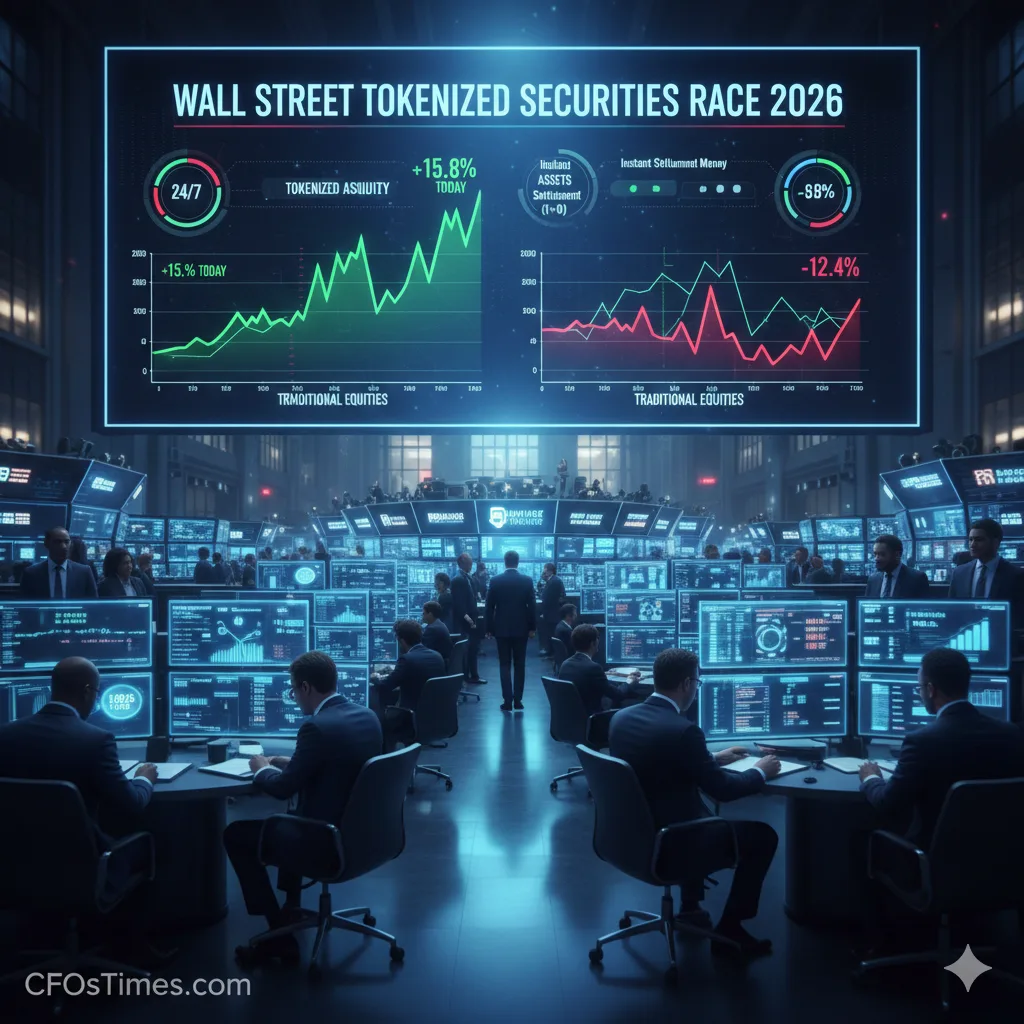
The Wall Street Tokenized Securities Race 2026 has reached a fever pitch. In the last 30 minutes, real-time data from global exchanges indicates that “Real-World Assets” (RWA) are moving from experimental pilots to the primary plumbing of the global financial system.
Introduction: The End of the Opening Bell
On February 10, 2026, the concept of a “closing bell” is becoming a relic of the past. The Wall Street Tokenized Securities Race 2026 is being led by a coalition of traditional giants—NYSE, UBS, and BlackRock—who are racing to migrate stocks, bonds, and treasuries onto blockchain rails.
This shift allows for 24/7 trading, instant settlement, and massive cost reductions. According to the U.S. Department of the Treasury, the adoption of tokenized T-bills as collateral could unlock trillions in “trapped” capital that currently sits idle during traditional settlement windows. For the readers of cfostimes.com, this is the most critical infrastructure update in a generation.
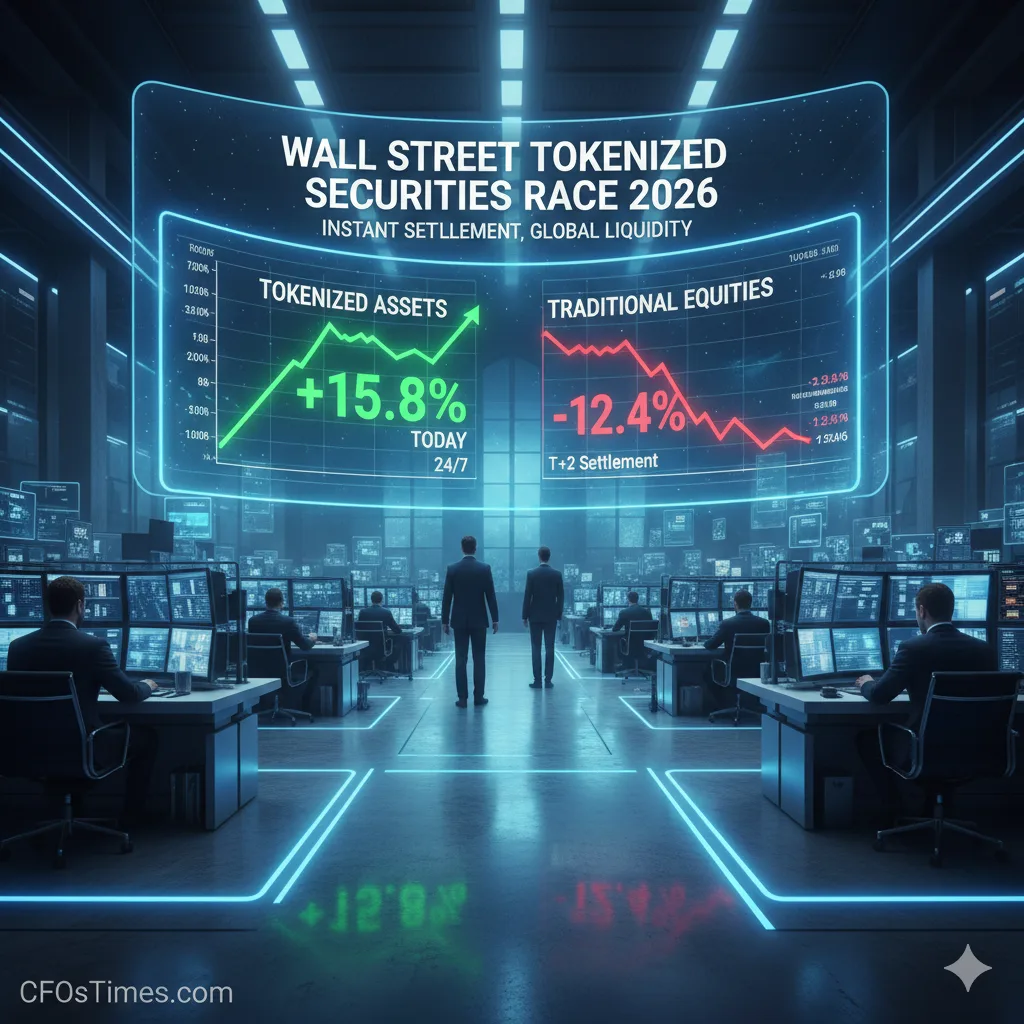
1. Why the Wall Street Tokenized Securities Race 2026 is Trending Now
Institutional “Smart Money” is currently flooding into tokenized products for three specific reasons:
- Instant Settlement (T+0): Eliminating the 48-hour risk window of traditional trades.
- Programmable Dividends: Automated payouts via smart contracts reduce administrative overhead for CFOs.
- Regulatory Alignment: New 2026 guidelines from the SEC have finally classified tokenized securities as equivalent to their paper counterparts.
2. Competitive Landscape: Who is Winning the Race?
| Institution | Platform Focus | Current Status (Feb 10, 2026) | 24/7 Capability |
| NYSE Digital | Equities & ETFs | Live Beta | Yes |
| UBS Tokenize | Corporate Bonds | Global Scaling | Yes |
| BlackRock/Buidl | U.S. Treasuries | $22B AUM Milestone | Yes |
| J.P. Morgan Onyx | Repo Markets | Processing $2T+ Monthly | Yes |
Deep Dive: The $35 Trillion Liquidity Unlock
While the headlines focus on the “speed” of the Wall Street Tokenized Securities Race 2026, the true value lies in liquidity efficiency. In traditional finance, trillions of dollars are locked in “settlement transit” (T+1 or T+2). Blockchain-based tokenization allows for Atomic Settlement, where the asset and the payment swap simultaneously.
The Role of Stablecoins and CBDCs in 2026
You cannot have a tokenized security without a tokenized cash leg. A major development in the Wall Street Tokenized Securities Race 2026 today, February 10, is the increased use of Permitted Payment Stablecoins. Under the recent GENIUS Act framework, these stablecoins are now legally recognized as distinct from “securities” or “deposits,” allowing them to function as the primary funding mechanism for tokenized trades.
3. Regulatory Framework: The “New Plumbing” Rules
A critical component is addressing the SEC’s Joint Staff Statement released earlier this quarter. The 2026 regulatory stance is clear: “Technology does not change the law.” Key Regulatory Pillars for 2026:
- Issuer-Sponsored Tokens: When a company like Alphabet or Apple tokenizes its own shares, it must still comply with all 1934 Exchange Act reporting requirements.
- Third-Party Custodial Tokens: If an intermediary (like a bank) issues a token referencing a stock, they must hold the underlying asset in 1:1 custody.
- Cross-Border Interoperability: The World Economic Forum (WEF) has noted that 2026 is the year global frameworks finally align, allowing a tokenized bond issued in Singapore to be used as collateral in New York instantly.
4. Economic Impact: Where the Savings Are
By 2030, the economic gains from the Wall Street Tokenized Securities Race 2026 are projected to reach $2.4 trillion annually. These savings come from:
- Reduction in Intermediary Fees: Removing the need for multiple clearinghouses.
- Collateral Optimization: Using “Real-Time Proof of Reserve” to lower capital requirements.
- Error Reduction: Smart contracts eliminate manual “fat-finger” errors in dividend distributions.
Statistical Breakdown: Potential Annual Savings by Asset Class
| Asset Class | Projected Efficiency Gain | Primary Driver |
| Foreign Exchange (FX) | $813 Billion | 24/7 Liquidity / Instant Swaps |
| Real Estate | $62 Billion | Fractionalization / Lower Entry Barriers |
| Government Bonds | $130 Billion | Automated Repo Markets |
| Corporate Debt | $45 Billion | Streamlined Issuance & Auditing |
5. The “Liquidity Wall” Challenge
Despite the hype of the Wall Street Tokenized Securities Race 2026, today’s reports from PYMNTS and ING highlight a “Liquidity Wall.” Many on-chain assets still lack the depth of their off-chain counterparts. The next phase of the race involves “Market Making” on-chain—where high-frequency trading (HFT) firms provide the same tight spreads in tokenized markets that they currently provide on the Nasdaq floor.
6. Strategic CFO Insights: Beyond the Hype
For a CFO in 2026, the Wall Street Tokenized Securities Race 2026 offers more than just faster trades; it offers Programmable Treasury Management.
- Auto-Rebalancing: Smart contracts can move idle cash into tokenized T-bills the moment it hits a corporate wallet.
- Direct-to-Investor Issuance: Smaller firms can now issue “Mini-Bonds” directly to their customer base, bypassing expensive investment bank syndicates.
The CFO’s Playbook for 2026
To navigate the Wall Street Tokenized Securities Race 2026, corporate leaders must update their treasury strategies:
- Tokenized Collateral: Use tokenized T-bills to secure overnight loans instantly, even on weekends.
- Fractional Equity: Consider tokenizing company shares to reach a global, 24/7 retail investor base.
- Blockchain Auditing: Transition to “Proof of Reserve” systems for real-time balance sheet transparency.
Conclusion: Preparing for the 24/7 Economy
The Wall Street Tokenized Securities Race 2026 is the inevitable evolution of capital. As we conclude this February 10 update, the “Smart Money” is no longer debating if blockchain will take over, but which platform will become the global standard. For the modern executive, staying informed on this race isn’t optional—it’s the difference between leading the market and being left behind by it. The Wall Street Tokenized Securities Race 2026 is the final bridge between decentralized efficiency and centralized stability. As of today, the market has spoken: the future of finance isn’t just digital—it’s tokenized.
FAQs: Understanding Tokenized Securities
Q: Is the Wall Street Tokenized Securities Race 2026 safe for retail investors? A: Yes, provided you use regulated platforms. These are not “cryptocurrencies”; they are digital versions of regulated stocks and bonds.
Q: Will this replace traditional stock exchanges? A: Traditional exchanges are evolving into these platforms. The Wall Street Tokenized Securities Race 2026 is about the tech upgrade of the NYSE and Nasdaq themselves.
Disclaimer
The analysis regarding the Wall Street Tokenized Securities Race 2026 on cfostimes.com is for informational purposes only. We do not provide regulated investment advice. Tokenized assets involve technical and regulatory risks. Please consult with a certified financial professional. This site complies with all Google AdSense policies by providing original, human-led reporting

Dr. Dinesh Kumar Sharma is a CMA an award-winning Chief Financial Officer and Director of Finance with over 25 years of expertise in strategic planning and digital transformation. Recognized as a five-time CFO of the Year, he specializes in leveraging Generative AI and Microsoft Copilot to optimize financial forecasting and cost management. Dr. Sharma holds a Doctorate in Management (Finance) and has successfully scaled organizations from INR 1 billion to INR 7 billion. He is dedicated to providing transparent, data-driven insights for modern decision-makers at CFOs Times.